
A lyophilised peptide vial is sealed under reduced pressure, but the vacuum that remains at the point of use varies from vial to vial and is not, by itself, a measure of quality. Stopper moisture, vial size, formulation and storage time all shift the headspace pressure after sealing, so a vial that draws diluent in strongly and one that draws almost nothing can both be sound. This article explains where the vacuum comes from, why it changes, how to handle a vial with strong, weak or no suction, and what a laboratory should verify through documentation instead. For batch-level assurance, Au Peptide Labs supplies research peptides stocked in Australia with third-party purity certificates, and the sourcing checks that matter are set out below.
All compounds discussed here are research materials for laboratory use only. They are not for human or veterinary use.
Au Peptide Labs supplies research peptides for laboratory research use only, each batch independently tested with a certificate of analysis.
Why a lyophilised vial contains a vacuum at all
Lyophilisation (freeze-drying) removes water from a frozen peptide solution by sublimation, so that the peptide remains as a dry, porous powder or "cake" that is stable at low temperatures for extended periods. In primary drying, the chamber is placed under a vacuum below the vapour pressure of ice and heat is applied so that ice sublimates, as described in a 2024 review of lyophilised formulation development.
That review also notes that chamber pressure during primary drying controls the sublimation rate and the heat and mass transfer in the product. It reports that holding chamber pressure consistently below 50 mTorr is difficult in practice and that there is little benefit in exceeding 200 mTorr. In other words, the pressure used during the cycle is a process variable chosen for drying efficiency. It is not a specification that the finished vial is meant to retain.
Vials are typically stoppered inside the chamber, or after backfilling with an inert gas such as nitrogen, depending on the process. A manufacturer may therefore deliver a vial with a partial vacuum, with near-atmospheric pressure or with slight positive pressure. Each is a legitimate outcome of a different cycle design, and the process used is a product-specific detail that the supplier's documentation, not the vial's behaviour, should establish.
Why vial pressure changes after sealing
The pressure measured at sealing is not the pressure at the time of use. A 1994 study of pressure in lyophilisation vials sealed vials at a chamber pressure below 20 mtorr and followed the headspace over time. Pressure rose to about 2 torr within roughly 50 hours and to 5 to 10 torr after about 2,300 hours, which is around three months. The authors attributed the rise primarily to water vapour desorbing from the rubber stopper. A hydrophilic product slowed the rise, and smaller vials showed a faster increase.
Three practical consequences follow for a laboratory:
- Time in storage matters. A vial opened weeks or months after sealing will not have the headspace it had on the day it left the freeze-dryer.
- Vial size and fill matter. The same quantity of desorbed vapour produces a larger pressure change in a small headspace, so small vials lose suction sooner.
- Formulation matters. Excipients and the peptide itself absorb part of the vapour, so two products in identical vials can behave differently.
Stopper material, stopper pre-treatment and the temperature history of the vial add further variation. A vial that has travelled through a warm depot will not necessarily match one kept cold throughout, which is one reason domestic dispatch with short transit times is a useful control. Au Peptide Labs ships from Australia within one business day of order, which removes customs holding time from that history; the peptide shipping guide covers the logistics in more detail.
What strong, weak or absent suction does and does not indicate
Many researchers treat the sensation of the diluent being pulled into the vial as a seal test. The evidence above shows why that inference is weak. Headspace pressure drifts upward over weeks and months even in a perfectly sealed vial, so reduced suction is the expected outcome of ageing, not a defect.
| Observation on piercing the stopper | Common explanations | What it does not establish | | --- | --- | --- | | Strong inrush when the seal is first punctured | Recent sealing, large headspace, deep vacuum at stoppering | That the product is higher in purity | | Slight or no suction | Pressure equalised after storage, stopper moisture desorption, backfilled gas, small vial | That the seal has failed | | Outward pressure when the seal is punctured (positive pressure) | Inert gas backfill, warm storage, residual vapour | That the contents are compromised | | Cake missing, collapsed, discoloured or wetted | Possible moisture ingress or temperature excursion | Needs documentary follow-up with the supplier |
The last row matters more than any suction check. Physical appearance of the cake, an intact crimp and stopper, and consistent labelling are better indicators than pressure. Where something looks wrong, the right step is to quarantine the vial and compare it against the batch certificate of analysis (COA), not to repeat the pressure test.
Checks that carry real information
- Crimp cap and stopper. The aluminium cap should be uniformly crimped and the stopper seated flat, with no cracks, displacement or residue.
- Cake appearance. A white to off-white, intact or lightly fragmented cake is typical. Shrinkage or collapse can occur with some sequences, so compare against the supplier's description for that compound.
- Batch documentation. The batch number on the vial should match an independent COA reporting purity by HPLC (high-performance liquid chromatography, the standard method that separates and quantifies the peptide and its impurities) and identity by mass spectrometry.
- Storage record. Record how long and at what temperature the vial was held before opening.
The counterfeit-peptide checks used by Australian labs and the sterility checklist aligned to USP and WHO guidance set out how documentation and release testing fit around these physical observations.
Handling a vial with residual vacuum during solubilisation
Solubilisation means dissolving the lyophilised cake in a suitable solvent to give a solution of known concentration. Pressure management is a minor part of the procedure, but a few points avoid avoidable errors.
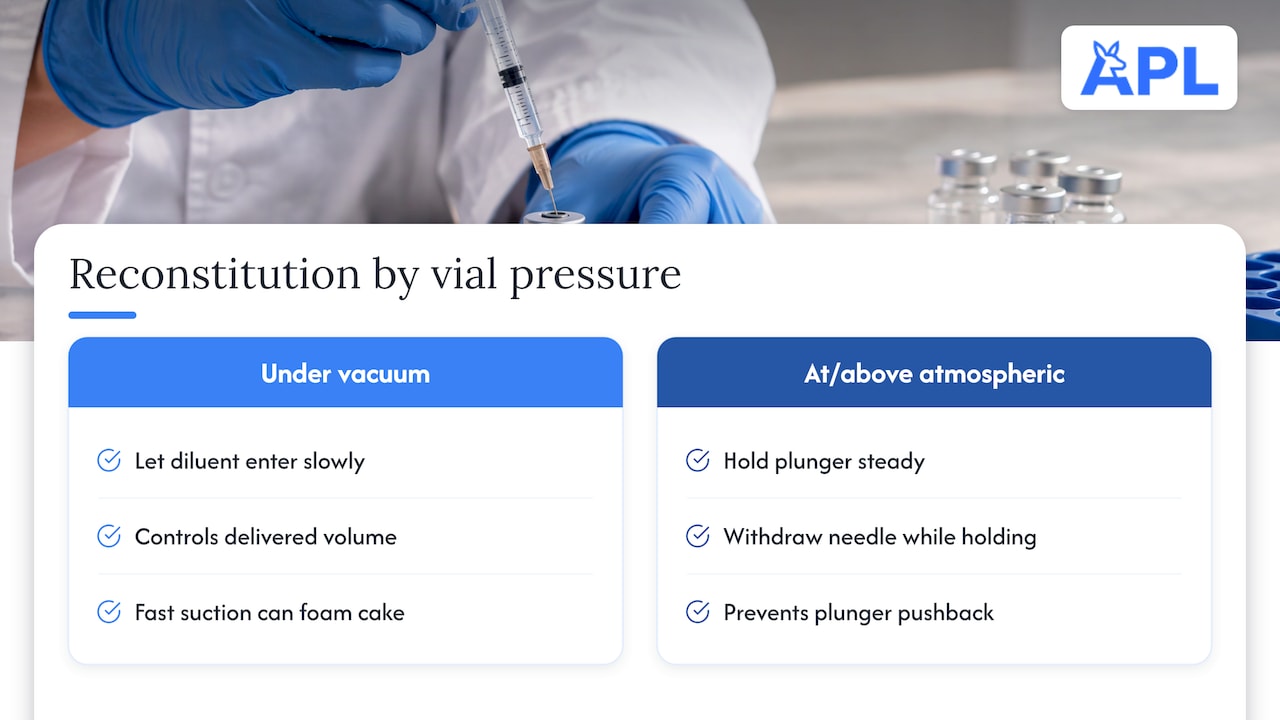
Equalise before you add
A vial under strong vacuum can draw solvent in rapidly and cause foaming; add solvent slowly.
Direct the stream at the glass wall
Whichever way the pressure sits, the diluent should run slowly down the inner wall of the vial rather than onto the cake. Mechanical stress can promote aggregation (clumping of peptide molecules) in protein and peptide formulations. A review of mechanical shock in protein vials reports industry experience that accidental drops can cause aggregation and particle formation, which is a reason to swirl gently and avoid vigorous shaking or dropping of vials at any stage.
Let the cake dissolve without agitation
Most cakes dissolve within a short time with gentle swirling. Persistent particulates, cloudiness or gel formation after the recommended time should be recorded with the batch number and referred to the supplier's technical contact rather than resolved by additional agitation or warming.
Stopper hygiene: each puncture is a contamination entry point; follow your institution's aseptic SOP.
How much diluent, and why no general rule applies
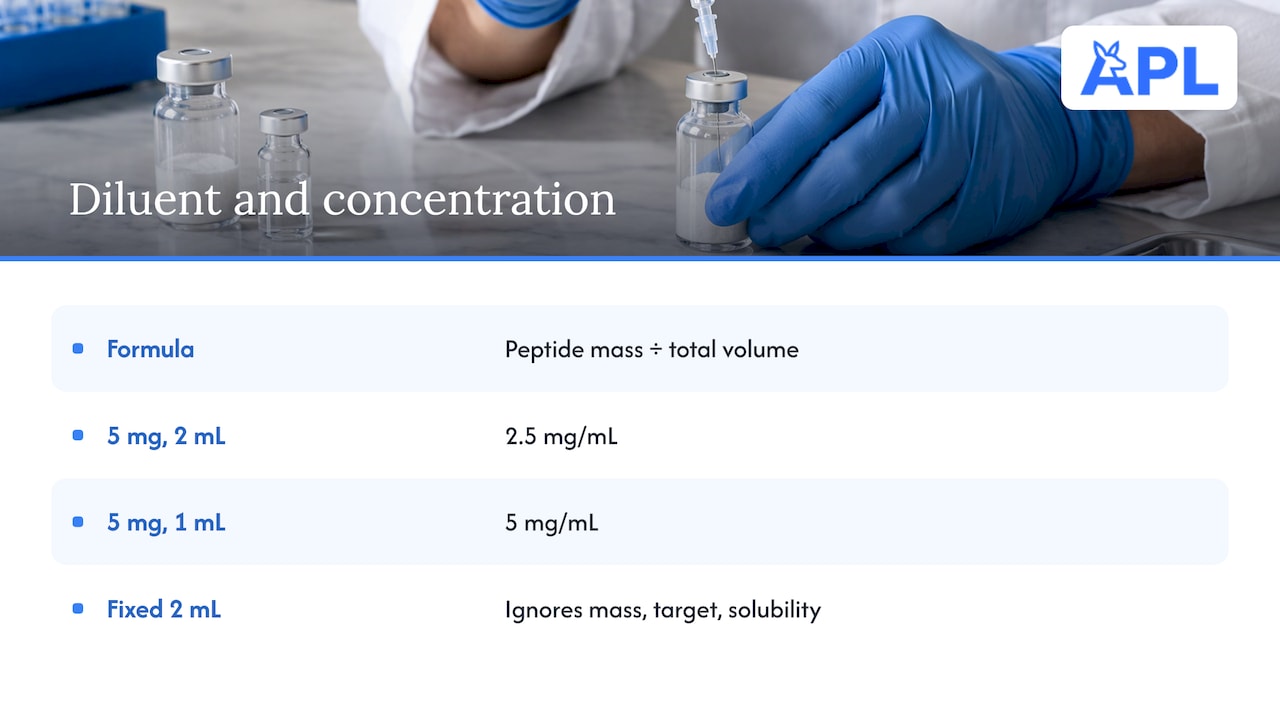
The volume of diluent determines the final concentration, and the correct figure depends on the vial's labelled peptide content, the concentration the experiment requires and the solubility of the particular sequence. A rule such as "add 2 mL to every vial" ignores all three. The calculation itself is simple: concentration equals peptide mass divided by total volume. The difficulty is knowing the mass to use.
Labelled vial content is usually the quantity of peptide material, which is not always the same as the quantity of active peptide, because salts and bound water account for part of the weight. The proportion that is peptide is the net peptide content, explained in the net peptide content glossary entry. A worked example: a vial containing 5 mg dissolved in 2 mL gives 2.5 mg/mL, and the same vial in 1 mL gives 5 mg/mL, so a pipetting error of 1 mL doubles the working concentration.
Solvent choice is equally compound-specific. Some sequences dissolve in sterile water, others require a mildly acidic or organic co-solvent. The supplier's compound data sheet is the starting point for each.
Storage after solubilisation
Once a peptide is in solution, water is available again as a reactant, and degradation processes such as hydrolysis, oxidation and aggregation proceed faster than in the dry state. For that reason, dissolved material is generally held refrigerated, protected from light and used within a short period set by the compound and the experiment's tolerance.
Freezing is a separate question. Repeated freeze-thaw cycles stress peptides and proteins in solution, and the usual laboratory approach is to avoid cycling a single vial. If material must be frozen, dividing it into single-use aliquots (small portions) means that each portion is thawed only once. Specific stability windows differ by sequence, so the figure for a given compound should come from its data sheet or from the laboratory's own stability work, and the date of solubilisation should be written on the vial with the concentration.
Undissolved vials are normally stored cold and dry, and allowed to reach room temperature before opening so that condensation does not introduce moisture into the vial.
Why pressure is a poor proxy for quality, and what to rely on
A procurement decision based on suction conflates a physical property that drifts with time with a chemical property that matters to the experiment. The properties that determine whether a batch is fit for a research protocol are:
- Purity and identity, shown by HPLC and mass spectrometry on the specific batch.
- Independence of the testing, meaning a third-party laboratory and not only an in-house result.
- Traceability, meaning a batch number on the vial that matches the certificate.
- Storage and transit conditions between production and bench.
- Sterility and endotoxin controls where the experiment requires them.
The local sourcing guide explains what to verify before ordering from an Australian supplier.
Our perspective
Vacuum is a by-product of how a vial was sealed, and it decays predictably as stopper moisture desorbs into the headspace. We therefore do not ask researchers to judge a batch by how hard the diluent is drawn in. A certificate of analysis tied to the batch number, issued by an independent laboratory, is the measure that carries scientific weight.
Our position is that the variables a supplier controls are the ones that should be documented: third-party purity testing above 99% with a verifiable COA for every batch, dispatch from Melbourne within one business day, and discreet packaging. Shorter domestic transit reduces the time a vial spends outside controlled storage, and it removes customs delays from the chain of custody.
For a laboratory, the practical outcome is a simpler record: batch number, COA, date received, date opened, date dissolved, concentration. With those entries, a change in suction between two vials is a footnote, not a question mark.
Au Peptide Labs editorial team
Research peptides and supplies stocked in Australia
Every product is sold for laboratory research only, and each batch carries a third-party purity certificate.
FAQ
Does a vial with no vacuum mean the peptide is spoiled?
No. Headspace pressure in sealed lyophilisation vials rises over time as water vapour desorbs from the stopper, so a vial opened weeks or months after sealing often has little suction. The contents are better assessed from the batch COA and the appearance of the cake and closure.
Should I add diluent quickly or slowly?
Slowly, down the inner glass wall and not onto the cake. This limits foaming and mechanical stress, and it keeps the delivered volume accurate when the vial still holds a partial vacuum. Swirl gently and avoid shaking.
How much diluent does a vial need?
The volume depends on the labelled quantity, the target concentration and the solubility of the sequence, so there is no single figure. Work out the concentration as mass divided by volume, using the net peptide content where it is stated, and follow the compound's data sheet.
Can dissolved peptide be frozen?
Repeated freeze-thaw cycles stress peptides in solution, so the usual practice is to avoid cycling one vial. Where freezing is necessary, single-use aliquots are thawed once each. The stability window for a given compound should come from its data sheet.
Sources
- Time-Dependence of Pressure in Lyophilization Vials, PDA Journal, 1994
- Practical advice in the development of a lyophilized formulation, PMC, 2024
- Mechanical shock in protein vials, Randolph, 2014