
If a peptide batch arrives without a matching Certificate of Analysis (COA), batch number and accredited lab signature, the correct response is to quarantine it immediately and commission independent testing before any research use. Verification hinges on three checks: COA authenticity, batch traceability and accredited testing methodology. Where doubt remains, commission NATA-accredited testing before the material is used.
Au Peptide Labs supplies research peptides for laboratory research use only, each batch independently tested with a certificate of analysis.
A verification checklist for incoming peptide batches
Every lot that arrives at a laboratory bench should pass through the same triage sequence before it touches an experiment. The process takes minutes and removes most of the guesswork that leads to compromised data or wasted reagents.
- Match the batch number printed on the vial, exactly, against the batch number quoted on the COA: any discrepancy is a rejection criterion, not a judgement call.
- Confirm the COA states the testing laboratory's name, its accreditation status, the test date and the analytical method used (HPLC or LC-MS), and request the underlying chromatograms rather than accepting a summary figure.
- Review the supplier's traceability documentation, including sample retention policy and storage history from manufacture to delivery.
- Watch for red flags: a COA that could apply to any batch, vials identified only by a code with no cross-reference, no laboratory contact details, or a purity statement with no method attached.
- When any of these checks fail, quarantine the material, log the lot in your inventory system, and arrange independent testing before release for use.
A batch number that matches is necessary but not sufficient. A reused or generic COA, lifted from a previous lot, is a known tactic for disguising unverified material, which is why cross-checking the physical vial against the document on file matters as much as reading the document itself.
Pro Tip: Photograph the vial label and COA together at intake and file both against the internal lot ID; this single habit makes later audits far faster to resolve.
For labs establishing a standing verification routine, our internal guide on local peptide sourcing covers the same checklist in more procurement-specific detail.
Reading a certificate of analysis properly
A COA is only useful if it contains enough detail to be independently checked, and a purity percentage on its own answers almost nothing about what else is in the vial.
A complete COA should include:
- The exact batch number, matching the physical vial.
- The test date and a report ID or analyst identifier that allows the testing lab to confirm the document on request.
- The testing laboratory's name and its accreditation status, ideally NATA accreditation against ISO/IEC 17025.
- The analytical method and its parameters: column type, wavelength, gradient and mobile phase for HPLC, or the relevant settings for LC-MS.
- Raw chromatograms or spectra, not just a summary purity figure.
HPLC area percent purity describes the relative area of one peak against the total chromatogram trace; it is not a direct statement of mass purity, and without the method parameters attached, the figure cannot be properly interpreted. USP guidance on peptide impurities notes that accurate impurity profiling typically requires orthogonal techniques, such as LC-MS alongside HPLC or NMR, rather than a single method taken in isolation.
To verify a COA in practice, confirm the batch number on the vial first, then request the raw analytical data, then contact the testing laboratory directly to confirm the report was genuinely issued against that lot. Where any of these steps cannot be completed to your satisfaction, commission independent testing: LC-MS for identity confirmation, a validated HPLC method for purity, and sterility testing where the product's downstream handling requires it.
Pro Tip: A COA with no lab contact detail and no report ID cannot be independently verified at all, treat that gap as equivalent to a missing COA.
Independent testing and accreditation pathways in Australia
When a COA cannot be confirmed, or a batch is flagged at intake, Australian laboratories have established routes to independent analysis rather than relying on supplier-provided paperwork alone. The National Measurement Institute offers pharmaceutical and analytical testing services, including method development and compliance testing relevant to peptide identity and purity work.
Accreditation signals matter at the lab level too: NATA accreditation and ISO/IEC 17025 certification indicate that a testing facility operates under documented, audited methods, and checking for these credentials on a COA or a lab's own site is one of the fastest practical trust checks available.
- Contact the testing laboratory first to confirm scope and obtain a quote before sending any sample.
- Complete the required submission form and package samples according to the laboratory's instructions, including courier arrangements during business hours.
- Request a defined panel: LC-MS for identity, a validated HPLC method for purity, and sterility or mycoplasma testing where the peptide will be handled under conditions where contamination risk is relevant.
Procurement controls that reduce supply risk
Verification at intake catches problems late. Procurement controls built into supplier onboarding and lab SOPs prevent most of them from arriving at all.
- Require batch-specific COAs and evidence of NATA or ISO/IEC 17025 testing partnerships as a condition of supplier onboarding, alongside a documented sample retention and traceability policy.
- Quarantine every new lot on arrival, retain a reference sample, assign an internal lot ID, and log COA metadata directly into the lab's LIMS or QA records.
- Favour Australian dispatch to reduce customs exposure, our shipping guide covers cold chain documentation expectations, and specify packaging and chain-of-custody terms directly in purchase orders.
- Escalate to QA whenever a COA fails verification, commission independent testing before release.
Why domestic sourcing matters for research continuity
Sourcing from Australian-based suppliers shortens the distance between order and bench, cutting the customs delays that disrupt time-sensitive protocols. Verified COAs and third-party testing, retained and cross-checked at intake, preserve the traceability chain that quality assurance teams rely on. Domestic supply, properly documented, removes one of the more common points of failure in peptide procurement.
— Au Peptide Labs editorial team
How Au Peptide Labs supports compliant procurement
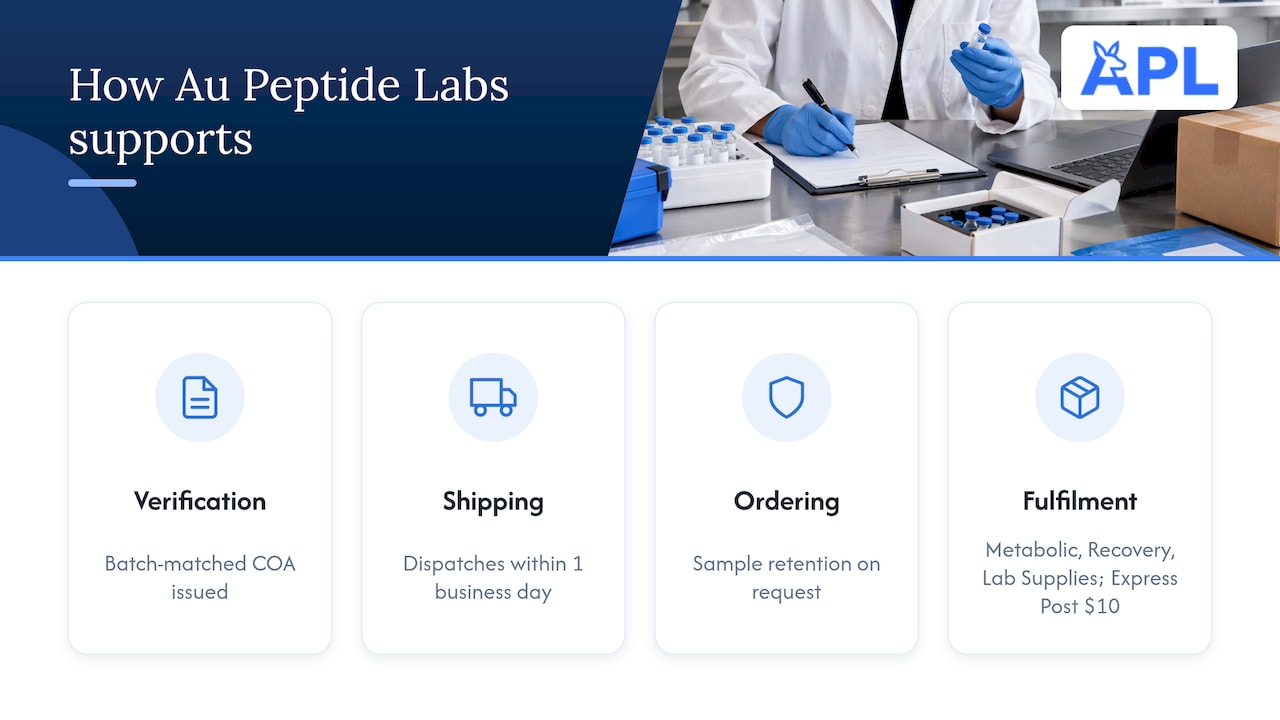
We supply high-purity research peptides from within Australia, with a third-party COA issued for every batch so the verification steps outlined above can be completed against documentation that actually traces back to the lot in hand. Orders dispatch domestically within one business day, avoiding the customs delays that come with overseas sourcing, and arrive in discreet packaging.
For labs ready to place a verified order, our full range is browsable here, with Express Post available for $10 one off.
This article is general information, not a substitute for advice from a qualified lawyer.
FAQ
What should I do if a peptide COA looks suspicious?
Quarantine the batch, log it under its own internal lot ID, and contact the testing laboratory named on the COA to confirm the report was genuinely issued for that batch number. If the lab cannot confirm it or the batch number does not match the vial, commission independent testing through a NATA-accredited facility before any research use.
Which tests should I request for an unverified peptide batch?
Request LC-MS for identity confirmation and a validated HPLC method for purity, adding sterility or mycoplasma testing where the peptide will be handled under conditions where contamination matters. The National Measurement Institute and other NATA-accredited laboratories in Australia offer these panels on request.
Does Au Peptide Labs provide a COA with every order?
Yes, we issue a third-party COA for every batch we dispatch, and orders ship from within Australia within one business day of purchase.
Sources
These are the primary regulatory and testing references cited throughout this guide, useful for labs confirming compliance obligations or arranging independent analysis directly.