
A store is most likely dropshipping when it holds no stock of its own, passes each order to a third-party supplier and leaves that supplier to ship the parcel directly to you. The usual signs are long or vague delivery windows, stock photos and copied descriptions, no verifiable local address or phone number, and parcels that arrive from overseas in several separate packages. For ordinary consumer goods this is a matter of patience and refunds. For regulated research products such as peptides, it is also a matter of traceability and storage conditions, which is why the signs deserve a closer reading.
Au Peptide Labs supplies research peptides for laboratory research use only, each batch independently tested with a certificate of analysis.
What dropshipping is and how an order moves
The Western Australian consumer protection agency describes dropshipping as a model in which the business does not keep the items in stock, takes the customer's order and passes it to another supplier, who delivers the product directly to the customer. The same page notes that the arrangement can lower costs for the retailer, but that the retailer then has less control over availability, quality control, delivery times and the true origin of the goods.
The sequence is straightforward:
- The customer pays the store's listed price.
- The store forwards the order, and part of the payment, to a supplier.
- The supplier packs and dispatches the item under its own handling conditions.
- The store never sees the product, so it cannot inspect, test or store it.
Dropshipping is a legal way to supply goods. The issue for buyers is not legality of the model itself but the distance it creates between the seller you pay and the party that actually handles the product. The same regulator points out that retailers must still comply with the Australian Consumer Law, and that a business should not take payment if it does not intend, or cannot be expected, to deliver what was paid for.
Signs that a store is dropshipping
No single sign is conclusive. Several together form a pattern. A widely used checklist from the WA regulator and the indicators ranking in search results converge on the same group of observations, set out below.
Delivery times and parcel behaviour
- Long or imprecise delivery windows. A store that quotes two to four weeks for an item it claims to stock locally is usually waiting for a supplier to ship from abroad.
- Multiple parcels for one order. Items from the same checkout arrive separately, from different senders, on different days.
- Tracking that begins overseas. The first scan is in another country even though the website describes the business as Australian.
- Customs wording. Shipping pages that mention customs charges, duties or delays for a store that presents itself as domestic are a strong indicator that goods cross the border after you pay.
Listings and branding
- Generic or stock imagery. Product photos that appear unchanged on marketplaces and other stores, which a reverse image search will show.
- Copied descriptions. Identical wording, including translation errors, on unrelated sites.
- A very broad catalogue. One store offering unrelated categories with no specialisation, with prices well below those seen elsewhere.
- Unstable pricing and stock. A product that is always available, then vanishes without notice, because the supplier's listing changed.
Business identity and support
- No phone number, or only a web form. Legitimate local sellers can generally be reached by phone or at a physical address.
- Missing legal notices. The German consumer centre network notes that many dropshipping sites omit legal notices and that return addresses are often supplied only on request.
- Appearance of local establishment. Austrian consumer advisers observe that shops may create the impression of being locally established while the supplier is in the Far East.
- Reviews that do not match the product. Reviews that are recent, uniform, off-topic or all posted in a narrow window.
A quick check you can run in ten minutes
| Check | What to look for | Concern if | | --- | --- | --- | | Reverse image search | Same photo on other shops | Many unrelated sellers use it | | Search a description sentence in quotes | Original source of the text | Appears word for word elsewhere | | Shipping and returns page | Dispatch location, time, return address | No address, or an overseas return address | | Business details | ABN, phone, physical address | Missing or not verifiable | | Review pattern | Dates, specific detail, mixed ratings | Uniform praise, generic wording | | Delivery promise | Specific dispatch window | "Up to 30 days" or none stated |
Why the consequences differ for peptides
For clothing or phone cases, a dropshipped parcel is mainly a delay risk. For research peptides, the supply chain itself is part of the product. Lyophilised peptides require controlled storage and handling, the identity and purity of the material is established only through batch-level testing.
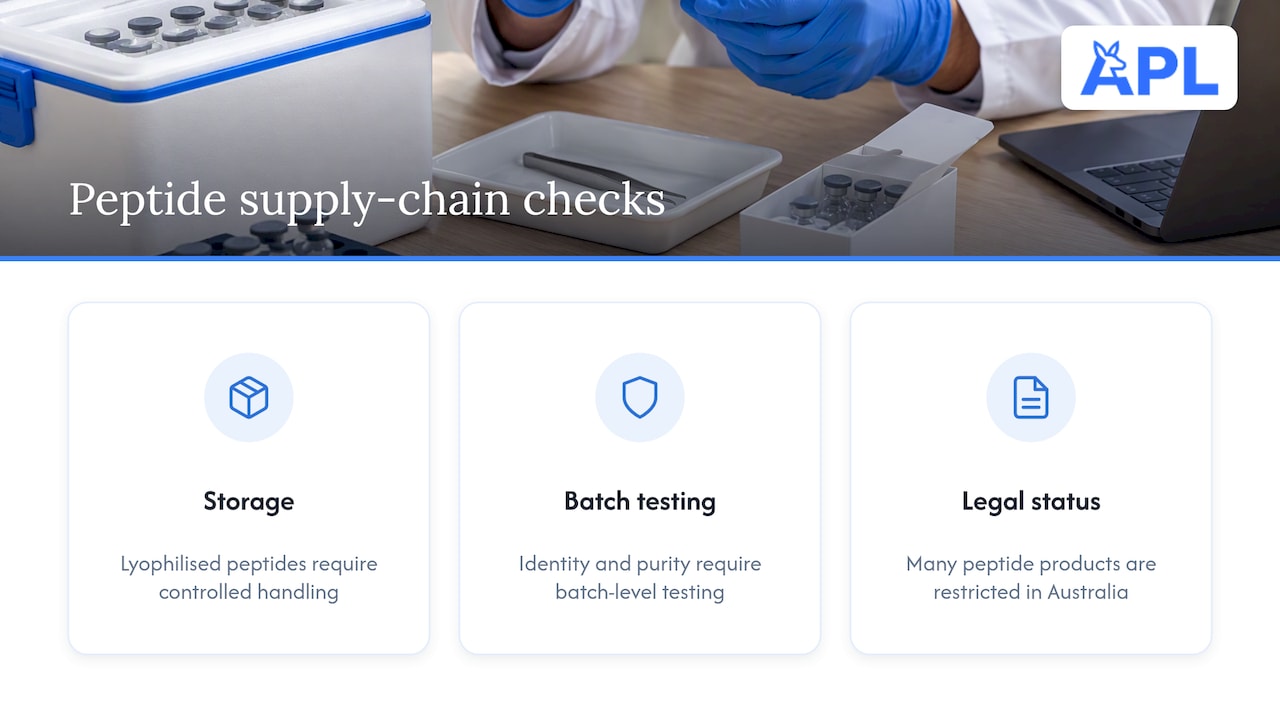
That guidance explains why a dropshipped peptide listing is a higher-stakes version of an ordinary dropshipping problem. A seller that has never held the vial cannot vouch for its storage, its batch or its certificate of analysis (COA).
Red flags specific to dropshipped peptides
Unmarked vials, code-only labels and missing ingredient information are major red flags. A guide to red flags in dropshipped peptide products covers the same indicators from a vendor-review perspective, including how listings and labels compare with what actually arrives.
In practice, laboratories should treat the following as grounds to stop:
- A vial with a code or lot number only, and no compound name on the label.
- A COA that is a generic image, carries no batch number, or cannot be matched to the vial received.
- A listing that gives a compound name but no mass per vial and no storage guidance.
- A parcel whose sender, return address or customs declaration does not match the seller's stated location.
- A seller that cannot state which laboratory tested the batch, and when.
Our own guidance on spotting counterfeit peptides in Australia expands these checks into a laboratory workflow.
Are peptides dangerous goods?
Readers often pair this topic with a second question: whether peptides count as dangerous goods when shipped. Dangerous goods classification depends on the specific substance, its form and quantity, and the carrier's rules, not on the word "peptide". Most lyophilised research peptides are supplied as small quantities of powder rather than as flammable, corrosive or toxic bulk materials, but the classification of any individual compound, and the carrier's acceptance of it, must be confirmed with the carrier and the supplier's safety data sheet. This should not be confused with legal restriction: a product can be unremarkable for shipping classification and still be an unapproved therapeutic good that is restricted under Australian law.
Why dropshipping is a poor fit for regulated research products
The drawbacks the WA regulator lists for customers are that remedies may take longer or become difficult when something goes wrong, because the retailer does not have the stock on hand. Applied to a peptide order, four specific problems follow.
| Issue | Dropshipped model | Stocked, locally dispatched model | | --- | --- | --- | | Batch traceability | Seller may not know which batch ships | Batch recorded at dispatch, linked to a COA | | Storage conditions | Unknown, controlled by supplier | Controlled by the stocking business | | Delivery path | Often cross-border, with customs exposure | Domestic dispatch, no import step for the buyer | | Problem resolution | Seller relays complaints to supplier | Seller holds the product and can inspect it |
The WA regulator adds that the cheapest option is not always the best choice, especially when the product is needed quickly or when the buyer wants assurance about where it comes from. In research settings, where a compromised vial can invalidate weeks of work, that point carries additional weight.
How to verify a peptide supplier before ordering
The ACCC's product safety guidance recommends checking ratings and reviews, whether the seller is legitimate, whether a regulated product meets the mandatory Australian standard, and whether it has been recalled.
For research peptides, a verification sequence suited to a laboratory is as follows:
- Confirm dispatch location. The shipping page should name the Australian city from which orders leave, and tracking should begin there.
- Request the batch COA before purchase. It should show the compound name, batch number, test date, method (typically HPLC and mass spectrometry) and the testing laboratory. An explanation of lot-specific COA verification shows how a certificate should tie to a particular lot.
- Match the vial label to the COA. Compound name, mass and batch should be identical.
- Check packaging. Vials should be sealed, labelled and shipped in appropriate protective material; see our guide to peptide packaging materials.
- Review the seller's local-sourcing claims. Our checklist for local peptide sourcing sets out what to verify.
- Retain records. Keep the order confirmation, COA and tracking for audit and, if needed, a report.
Our perspective
We regard dropshipping as a sound model for low-risk consumer goods and an unsuitable one for research compounds. A research peptide is defined by its batch: the purity figure, the identity confirmation and the storage history all belong to a specific lot, and a business that never handles the lot cannot document any of them. The question we advise researchers to put to any supplier is simple: where is the vial physically held before it reaches me, and which certificate belongs to that exact vial?
Our own model is built around that question. Stock is held in Australia, shipments are dispatched from Melbourne within one business day, each batch is independently third-party tested to a purity above 99% with a COA that can be verified, and packaging is discreet. Because orders leave a domestic location, the buyer does not carry the customs exposure that accompanies overseas dispatch.
— Au Peptide Labs editorial team
Research peptides held in Australian stock
Supplies are for laboratory research use only.
Frequently asked questions
How can I tell quickly whether a store is dropshipping?
Look at the shipping page, the contact details and the product photos. Vague delivery windows, no phone number or physical address, mentions of customs charges and images that appear on many other sites together make dropshipping very likely. Tracking that starts overseas confirms it.
Is dropshipping illegal in Australia?
No, the model itself is legal, as the WA consumer protection agency notes. Retailers must still comply with the Australian Consumer Law, including not taking payment for goods they cannot supply within a reasonable time. What is sold through it can still be restricted, which is the case for many peptide products.
Are peptides dangerous goods when shipped?
Classification depends on the individual substance, form and quantity, and on the carrier's rules, so it cannot be answered for peptides as a class. Confirm it with the carrier and the supplier's safety data sheet.
What should a peptide label and certificate show?
The vial should name the compound and state mass, batch number and storage conditions. The COA should carry the same batch number, the test method and the testing laboratory. Code-only labels or missing ingredient information are major red flags.