
A certificate of analysis (COA) and a safety data sheet (SDS) answer different questions and neither replaces the other. A COA reports what analytical testing found in one specific batch, typically identity and purity. An SDS communicates how a substance can harm people and how to store, handle and dispose of it safely. A research laboratory in Australia needs both on file before a vial is opened. Au Peptide Labs supplies research peptides tested by an independent third party to a purity of 99% or above, with a verifiable COA for every batch, dispatched from Melbourne.
This article sets out what each document establishes, how the Australian rules shape the SDS, how to reconcile a COA with the vial in hand, and what to do when either document is missing or does not fit the product. It is written for laboratory staff, procurement officers and researchers, and it explains each term where it first appears.
Au Peptide Labs supplies research peptides for laboratory research use only, each batch independently tested with a certificate of analysis.
The short comparison
| Feature | Certificate of analysis (COA) | Safety data sheet (SDS) | | --- | --- | --- | | Core question | What is in this batch, and how pure is it? | What hazards does this substance present, and how is it handled safely? | | Scope | One lot, tied to a lot number | The substance or product, revised when information changes | | Typical content | Peptide name, lot number, HPLC purity, mass spectrometry identity, test date, method | Hazard identification, first aid, handling and storage, exposure controls, disposal | | Main user | Researcher judging material quality and traceability | Work health and safety (WHS) officer, laboratory manager, emergency responders | | Governing framework in Australia | Supplier and laboratory quality practice | Model WHS Code of Practice and GHS 7 | | What it does not show | Hazards, handling rules, safety for any use | Purity or identity of a particular batch |
The rest of the article explains each row.
What a COA establishes
A COA is a lot-specific analytical report. It links one lot number to the tests run on that lot, the methods used and the results obtained. For a research peptide, three results carry most of the weight.
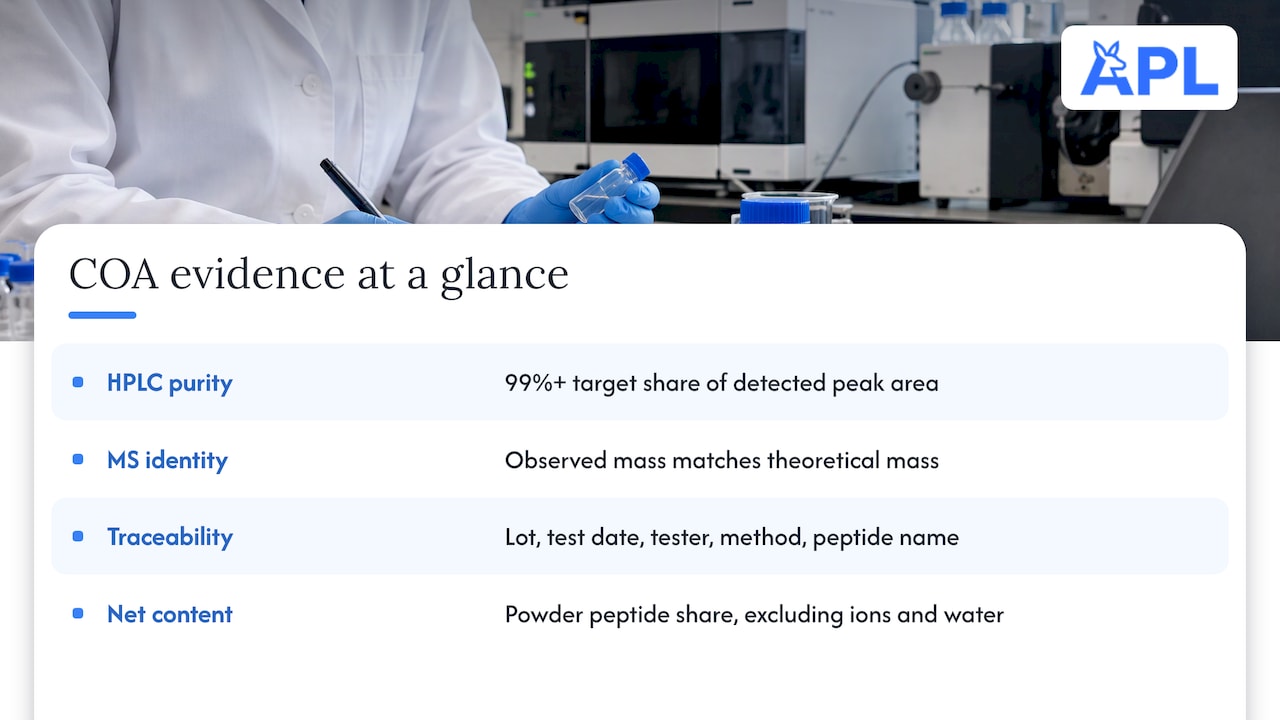
Purity by HPLC. High-performance liquid chromatography (HPLC) separates the components of a sample and reports the share of the total signal that belongs to the target peptide, usually as a percentage. A figure of 99% or above means the target peptide accounts for that share of the detected peak area. It describes relative purity of the detected material, not the total mass of peptide in the vial.
Identity by mass spectrometry. Mass spectrometry (MS) measures the molecular mass of the compound. The observed mass should match the theoretical mass calculated from the peptide sequence, within the tolerance of the instrument. This is the result that confirms the vial contains the sequence named on the label rather than a different molecule with a similar chromatogram.
Traceability fields. Lot number, test date, the testing body, the method and the stated peptide name allow the document to be matched to the physical batch. A COA that cannot be tied to a lot number is a general statement, not batch evidence.
Purity and net peptide content are separate quantities. Net peptide content is the proportion of the lyophilised powder that is peptide, as opposed to counter-ions and residual water. It matters when a laboratory calculates concentrations by weight. The Au Peptide Labs glossary entry on net peptide content explains the distinction and its effect on dilution work.
What a COA does not establish
A COA reports specified tests on a named batch. It does not describe hazards, it does not set handling rules, and it is not an assessment of suitability for any application. A COA is therefore analytical documentation for laboratory research material. It is not evidence of sterility or of fitness for any therapeutic purpose, and Au Peptide Labs products are for laboratory research only, not for human or veterinary use.
What an SDS establishes
A safety data sheet is the hazard-communication document for a chemical. Safe Work Australia's model Code of Practice describes it as a document that provides critical information about hazardous chemicals: identity and ingredients, health and physical hazards, safe handling and storage, emergency procedures and disposal. The model Code of Practice on preparing safety data sheets requires 16 fixed sections, running from identification in Section 1 to any other relevant information in Section 16. Missing information must be stated clearly and not left blank.
For a laboratory the sections that drive daily decisions are these:
- Section 2, hazard identification: the classification and label elements, including any hazard statements.
- Section 4, first aid measures: what to do after skin or eye contact, inhalation or ingestion.
- Section 7, handling and storage: conditions for safe storage, including temperature and incompatibilities.
- Section 8, exposure controls and personal protection: ventilation, gloves, eye protection and any exposure limits.
- Section 10, stability and reactivity: conditions and materials to avoid.
- Section 11, toxicological information: what is known about health effects.
- Section 13, disposal considerations: how waste and contaminated packaging are managed.
The SDS is what a WHS officer files in the hazardous chemicals register and what an emergency responder reads first. It says nothing reliable about the purity of any particular lot.
Research peptides and incomplete hazard data
Many research peptides have not been fully characterised toxicologically. Safe Work Australia's Code addresses this: where a research chemical's hazard properties are not fully known, WHS Regulations Schedule 7(2) allows an SDS that is in English, names the manufacturer or importer with an Australian address and business phone number, and states that full identification or hazard information is unavailable and that a precautionary approach is required. It also gives the chemical identity, structure or composition as far as practicable, and lists any known or suspected hazards and precautions, as set out in the earlier edition of the same Code.
In practice, an SDS for a research peptide that says hazard data are limited is not defective. The laboratory should treat the material under that precautionary approach: standard personal protective equipment, handling powders in a way that avoids generating dust, and no assumption of harmlessness.
The Australian rules that shape the SDS
Two regulatory points affect how SDSs are read in 2026.
GHS 7. Safe Work Australia's transition page for GHS 7 states that since 1 January 2023 the seventh revision of the Globally Harmonized System of Classification and Labelling of Chemicals (GHS 7) must be used in Australia to classify and label hazardous chemicals, and that manufacturers and importers must use it to prepare SDSs. Stock manufactured or imported on or after that date must be labelled, and have an SDS prepared, in accordance with GHS 7. An SDS still citing an older revision on recently imported stock deserves a query to the supplier.
Workplace exposure limits. The same page records that workplace exposure limits (WELs) replace the former workplace exposure standards (WES) on 1 December 2026, and that workplaces must continue to comply with WES until then. Safe Work Australia's April 2024 document on airborne contaminant limits notes that the standards were renamed, some limits were modified after review, and it identifies the SDS and the Hazardous Chemical Information System (HCIS) as the best sources for a substance's hazard classification. Laboratories that cite exposure limits in risk assessments should update the terminology and check each limit against the current table.
Timing of the SDS. The Code also provides that if an SDS cannot practicably be prepared before a hazardous chemical is first manufactured or imported, it must be prepared as soon as practicable afterwards and before first supply to a workplace. It must be amended when new information becomes known or the formulation changes. An SDS therefore has a revision life, whereas a COA is fixed to its batch.
Reconciling a COA with the vial
A COA is only as useful as its match to the physical material. A sequential receiving routine takes a few minutes per lot.
- Match the name and sequence. The peptide name on the COA, the label and the purchase order should agree, including salt form where stated.
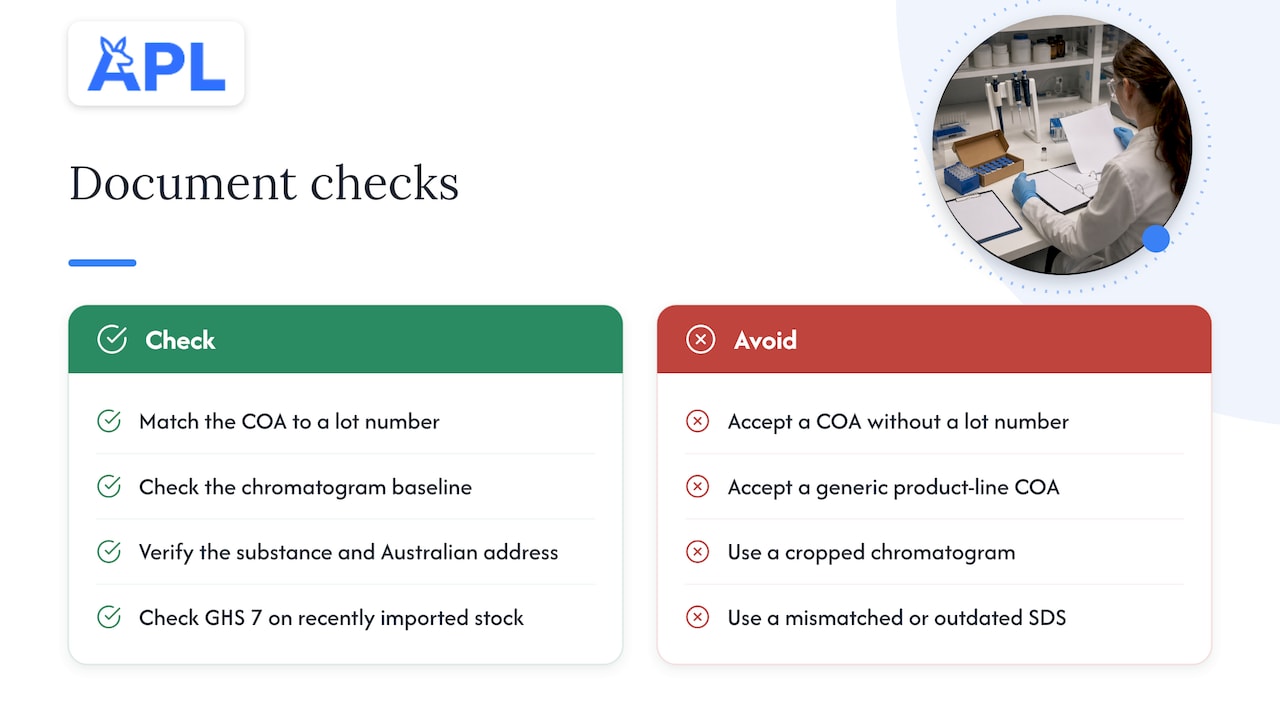
- Match the lot number. The lot number printed on the vial must equal the number on the COA. A COA that quotes a product family but no lot is not batch evidence.
- Read the HPLC result. Look at the stated percentage, the detection wavelength and the chromatogram if provided. A single dominant peak consistent with the stated purity is the expected pattern.
- Compare observed and theoretical mass. The mass spectrum result should sit within the instrument's tolerance of the calculated value for the sequence. For larger peptides the report may list multiply charged ions; the deconvoluted mass is the figure to compare.
- Check the testing body and date. Independent third-party testing carries more weight than an in-house statement, and the test date should precede dispatch.
- Record both documents. File the COA against the lot in the inventory record and the SDS in the hazardous chemicals register, with the SDS revision date noted.
The supplier verification guide from Au Peptide Labs sets out how these documentary checks fit within wider supplier qualification, and the article on counterfeit peptide checks used by Australian labs covers lot, label and packaging consistency.
Where each step goes wrong
The commonest failures are documentary rather than analytical. A COA carries a purity figure but no lot number. A COA is generic for a product line. A chromatogram is cropped so the baseline cannot be assessed. An SDS lists a different substance, or a manufacturer with no Australian address. An SDS predates the GHS 7 requirement for stock imported after 1 January 2023. Each of these is a mismatch between document and material, and each should be resolved before the material enters use.
Au Peptide Labs publishes a verifiable COA for every batch, with products independently tested by a third party to 99%+ purity. Because stock is held and dispatched from Melbourne within one business day, a laboratory can reconcile the paperwork against a delivery that has not passed through overseas customs, which removes a common cause of delays and of relabelled or repackaged consignments.
When a document is missing, generic or mismatched
A laboratory should treat the following situations as holds on the material, not as administrative gaps.
- No SDS supplied. A workplace supplied with a hazardous chemical needs the SDS before use. Quarantine the vial, request the current SDS in writing from the supplier, and file the response. Where hazard data are incomplete, the Schedule 7(2) wording described above is the acceptable form.
- No COA, or a COA without a lot number. Request the lot-specific report. Hold the vial unopened and record the request date.
- COA and label disagree. Do not resolve the discrepancy by assumption. Return to the supplier with both documents and the lot number, and keep the vial segregated.
- Outdated SDS. Ask the supplier whether the formulation or classification has changed since the revision date, since the Code requires amendment when new information is known.
- Documents in another language or without an Australian contact. The Code expects an English SDS naming a manufacturer or importer with an Australian address and business phone number.
Exposure questions should go to the institution's WHS officer.
Perspective
Documentation is the first piece of quality control a laboratory touches, and it is the one most often reduced to a single number. A purity percentage on its own cannot be traced to a lot, and a hazard sheet on its own says nothing about what is in the vial. We treat the two documents as a pair that must each be present, current and matched to the batch.
This is why we publish a verifiable COA for every batch, tested independently to 99%+ purity, and why we dispatch from Melbourne within one business day. Domestic dispatch keeps the document trail short: the lot that was tested is the lot that arrives, without the delays customs processing can introduce. Packaging is discreet, and every product is supplied strictly for laboratory research, not for human or veterinary use.
For researchers building a procurement file, our advice is to reconcile the COA, label and purchase order at receipt, file the SDS against the hazardous chemicals register, and record both against the lot. That routine takes minutes and removes most downstream disputes about material provenance.
Au Peptide Labs editorial team
Choosing research material with the documents in mind
Orders are dispatched from Australia within one business day, and Express Post is available for $10. The research peptide range and its third-party tested batches are available at aupeptidelabs.com.au.
Frequently asked questions
Does a COA replace an SDS?
No. A COA documents analytical results for a specific batch, such as purity and identity. An SDS communicates hazard and handling information under the Australian WHS framework. A laboratory needs both, and the SDS must be available to workers before they handle the chemical.
Is an SDS valid if it says hazard information is unavailable?
For a research chemical whose hazards are not fully known, yes. Schedule 7(2) of the WHS Regulations accepts an SDS that states full hazard information is unavailable and that a precautionary approach is required, provided it also gives the identity or composition as far as practicable and lists known or suspected hazards and precautions.
How often does an SDS change?
When new hazard information emerges or the formulation changes, the manufacturer or importer must amend it. Australia's move to GHS 7 from 1 January 2023 also means stock imported after that date needs an SDS prepared under that revision.
Sources
- Preparation of safety data sheets for hazardous chemicals, Safe Work Australia model Code of Practice (June 2023)
- Preparation of safety data sheets for hazardous chemicals, Safe Work Australia model Code of Practice (2020 edition)
- Adoption of GHS 7, Safe Work Australia
- Workplace exposure limits for airborne contaminants (April 2024)