
Peptide isomerization is a change in the arrangement of atoms within a peptide that leaves its molecular mass unchanged. Typical examples are the conversion of L-amino acids to D-isomers and the non-enzymatic conversion of aspartate to isoaspartate. These are zero-dalton modifications that can still profoundly alter a peptide's physicochemical characteristics and three-dimensional structure. For a laboratory, this matters because an isomerized peptide can sit undetected in a sample that looks correct on a mass readout. Au Peptide Labs supplies research peptides with third-party purity certificates (COAs) for every batch, which is the documentation a laboratory needs to interpret what it has on the bench. All products are for laboratory research only.
Au Peptide Labs supplies research peptides for laboratory research use only, each batch independently tested with a certificate of analysis.
What peptide isomerization means
Isomers share the same elemental formula but differ in how the atoms are connected or arranged in space. In peptides, three changes account for most of what researchers encounter:
- Aspartate to isoaspartate rearrangement, where the peptide backbone connectivity changes.
- Epimerization, where one chiral residue is inverted, for example L to D.
- Cis-trans isomerization of the peptide bond, most relevant at proline.
Because none of these adds or removes atoms, the peptide keeps the same mass. A change of this kind is invisible to a simple mass check, which is why it is treated as a distinct analytical problem. For background on how modifications are classified, see the overview of peptide modifications in research.
A note on terminology: tautomerization, which appears in related searches, is a different process. Tautomers are structural isomers that interconvert through the shift of a proton and a double bond, typically within a small molecule. Peptide isomerization, as discussed here, concerns the residues and bonds of the peptide chain itself.
Aspartate, succinimide and the four isomeric forms
The best-characterised route starts with aspartic acid. Its side chain attacks the backbone to form a five-membered succinimide ring. Simple ring opening yields a mixture of aspartic and isoaspartic acid, while inversion of the chiral alpha hydrogen in the ring can produce D-aspartic and D-isoaspartic acid. That gives four isomeric states: L-Asp, D-Asp, L-isoAsp and D-isoAsp. None is distinguished by a mass shift.
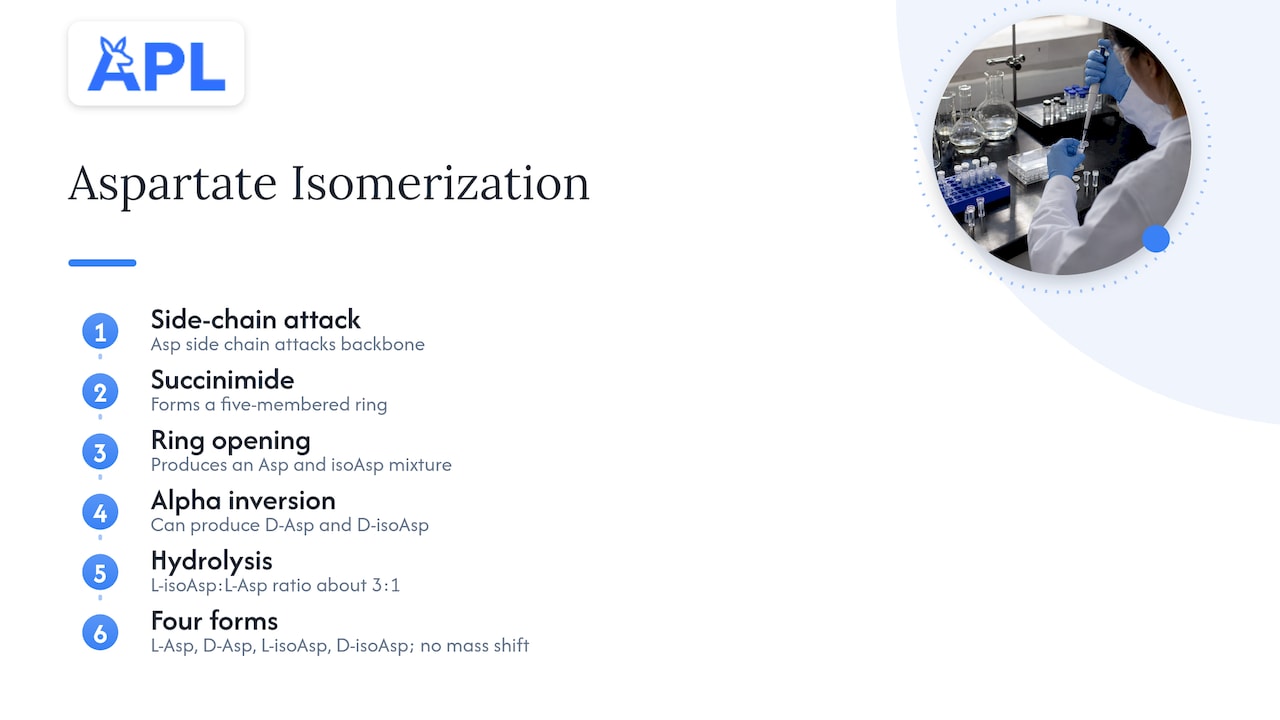
Under physiological conditions, the L-succinimide intermediate hydrolyses to L-isoaspartate and L-aspartate in a ratio of about 3:1, so L-isoAsp is typically the main product of the non-enzymatic reaction. The same succinimide intermediate also forms from asparagine during deamidation, which is why the two processes are often studied together; the mechanism and rates are covered in our guide to deamidation in peptides.
Structurally, isoAsp inserts a methylene group into the backbone, forming a kink that can alter tertiary structure.
Epimerization and D-amino acids
Epimerization inverts a single chiral centre while leaving the rest of the peptide untouched. The consequences can be large in either direction. According to a 2024 review, D-amino acids in peptides can enhance stability against enzymatic degradation and significantly increase biological activity. The example given is the neuropeptide GdFFD, which contains D-phenylalanine and regulates feeding in Aplysia californica, whereas its all-L counterpart is inactive.
D-residues also change conformation: substitution can significantly reduce a peptide's tendency to form alpha-helical structure. The same review notes that L-to-D isomerase activity has been detected in rat lung, spinal cord and cerebellum tissue, but that the endogenous presence of D-amino acid-containing peptides in mammals remains unconfirmed.
Proline cis-trans isomerization
Unlike the two processes above, proline isomerization is a change of conformation around the peptide bond rather than a change in chemical connectivity. According to a 2023 review, the two forms interconvert at about 2.5 × 10⁻³ s⁻¹ at 25 °C, which is slow because the energy difference between conformers is small. Peptidyl-prolyl isomerases (cyclophilins, FKBPs and parvulins) accelerate the conversion 10³ to 10⁶ fold without changing the equilibrium constant.
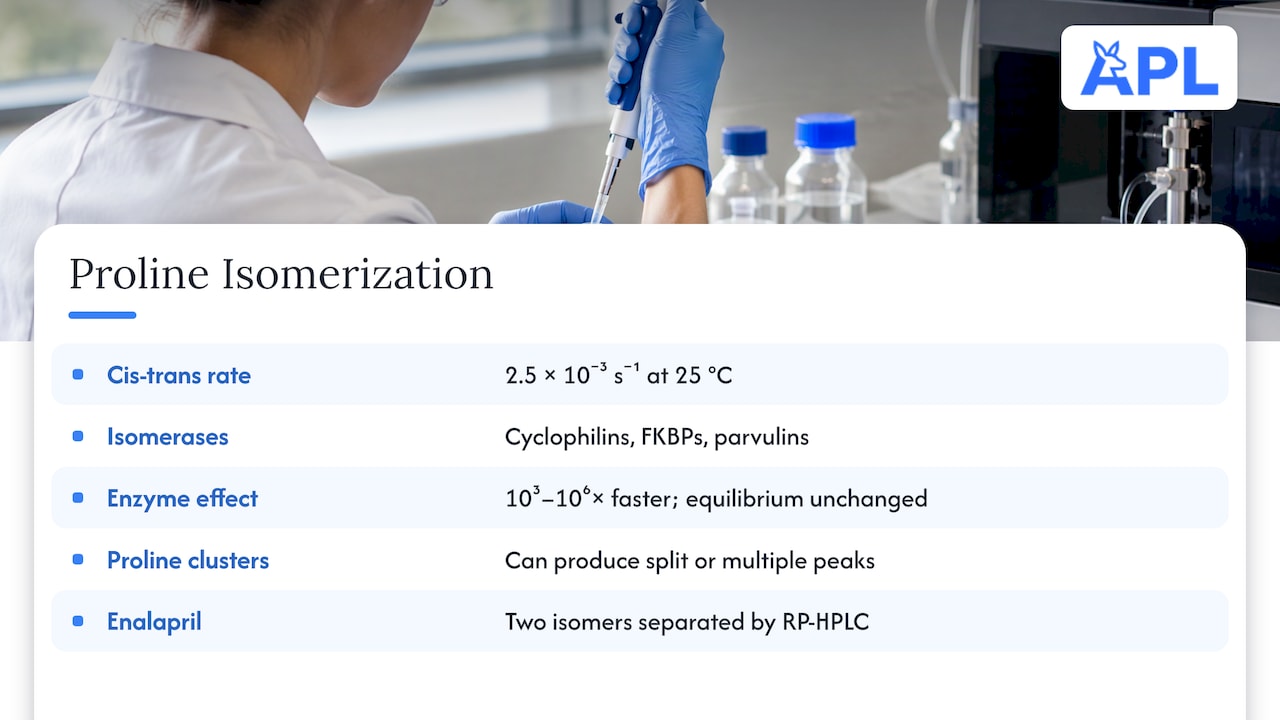
For analysts, the practical effect is chromatographic. Cis and trans forms can produce split or multiple peaks, particularly when several prolines sit close together in the sequence. The ACE inhibitor enalapril is a documented case: its two proline isomers have different retention times and can be separated by RP-HPLC. The same review reports that adding certain salts to proline-containing solutions can shift the bond toward the cis form.
What drives isomerization
| Factor | Effect | Relevant isomerization | | --- | --- | --- | | Aspartyl sequence context (for example Asp-Gly motifs) | Favours succinimide formation | Asp to isoAsp, D-Asp | | Time under solution conditions | Slow, cumulative conversion | Asp to isoAsp | | Synthesis conditions | Isomers can arise as a byproduct | Epimerization, isoAsp | | Counter-ion and solvent environment | Can shift the cis/trans balance | Proline | | Sample preparation | Can induce isomerization artefactually | Asp to isoAsp |
A 2021 study of a recombinant monoclonal antibody observed Asp-succinimide conversion in Asp-Gly motifs, using 18O labelling with LC-MS to resolve the kinetics. A 2022 study adds that isomerization can occur as a synthesis byproduct or spontaneously. The same 2021 paper stresses that peptide mapping methods must be optimised to avoid method-induced isomerization, so handling matters as much as storage. Solution pH is one controllable variable; see our notes on peptide pH stability.
Why isomerization matters for structure and function
Both isomerization and epimerization significantly perturb local structure at the affected residue. Documented consequences include:
- Resistance to proteolysis. Conversion of Asp to L-isoAsp prevents digestion of the N-terminal portion of amyloid-beta by cathepsin L, and isomerized or epimerized sites resist several classes of peptidase.
- Altered aggregation. Racemization of serine residues in beta-amyloid increases its aggregation rate.
- Altered activity. As noted above, D-residues can switch a peptide from inactive to active.
These findings come from in vitro and tissue studies. They describe mechanisms in the research literature and are not guidance for any use of peptides in people or animals.
How researchers detect and distinguish isomers
The central difficulty is that Asp isomerization is silent in mass spectrometry because it does not change elemental composition. Structural changes usually alter reversed-phase retention time, so chromatography gives the first separation. A 2021 review notes that C18, C8 and C4 phases can distinguish diastereomers, including peptide epimers, but not enantiomers. Our comparison of HPLC and mass spectrometry sets out what each technique can confirm.
Beyond that, several approaches are in use:
- Tandem MS with statistics. A 2024 JASMS paper showed that MS2 spectra cannot reliably localise isomerization sites, because isomerization can affect fragmentation at residues remote in sequence but close in the folded structure. MS3 experiments with statistical analysis of fragment ions identify which fragments contain the site, and the method is compatible with quantifying isomer mixtures.
- Ion mobility. Cyclic ion mobility MS showed distinct conformational differences between a therapeutic peptide and three synthetic isoAsp variants, and located the isomerized Asp in each case.
- Enzymatic labelling. A 2025 workflow combined CID-trapped ion mobility with PIMT labelling to localise isoAsp residues in eight peptides from rat hypothalamus and identified a D-amino acid-containing form of FMRFamide.
- HCD fragmentation of epimers. Higher-energy collisional dissociation has been used to characterise the D-amino acid position in epimers of a lipidated therapeutic peptide.
Some of these methods need supplemental ion sources or modified instruments, so access varies between laboratories. For routine identity checks, see our practical guide to mass spec peptide verification. A concise definition of the phenomenon and its relevance is also available in this reference entry on a peptide in the research-reagent catalogue context.
Interpreting samples: isomers as impurities
IsoAsp formation is a common isobaric impurity in therapeutic peptides, and it can be hard to identify without synthesising isoAsp standards for chromatographic comparison. Isomerized peptides must be fully characterised as potential impurities before clinical development. Accurate quantitation of the variants, together with kinetic understanding, supports process development and product quality control. The wider impurity landscape is described in peptide impurities: types, origins and detection.
For a laboratory, a working checklist follows from this:
- Request a batch-specific COA with HPLC purity and mass confirmation.
- Record sequence features that favour succinimide formation, such as Asp-Gly.
- Keep solution handling consistent so that isomerization is not introduced during preparation.
- Treat an unexpected split peak as a prompt to consider isomers, not only contamination.
Perspective
Isomerization is the clearest case where a purity figure and a mass value cannot tell the whole story. A peptide can match its theoretical mass and still carry isoAsp, a D-residue or a slow-exchanging proline conformer.
Our position is that documentation should travel with the material. Au Peptide Labs stocks research peptides tested independently by a third party to 99%+ purity, with a verifiable COA for every batch, and dispatches from Melbourne so that material is not held in transit. We think reproducible research begins with a traceable batch record and sensible handling afterwards.
Researchers who build their interpretation on that record are better placed to attribute a result to the peptide, not to an unrecognised variant.
Au Peptide Labs editorial team
FAQ
Does isomerization change a peptide's molecular weight?
No. Isomers share the same elemental composition, so the mass is identical. That is why separation by retention time, ion mobility or specialised fragmentation is needed to tell them apart.
What is the difference between isomerization and tautomerization?
Tautomerization is the rapid interconversion of structural isomers through the movement of a proton and a double bond. Peptide isomerization involves changes to residue configuration or backbone connectivity, such as Asp to isoAsp or L to D.
Is Asp to isoAsp conversion reversible?
The succinimide intermediate hydrolyses mainly to L-isoAsp and L-Asp in roughly a 3:1 ratio. The isoAsp product itself is the stable end form of the non-enzymatic pathway, so it accumulates over time.
Can proline isomers be mistaken for impurities?
Yes. Cis and trans forms can appear as split or multiple chromatographic peaks, particularly where prolines are clustered. Comparing retention behaviour under different conditions helps separate conformers from true impurities.
Sources
- Recent Advancements in the Characterization of D-Amino Acid-Containing Peptides (2024)
- Identification of Amino Acid Epimerization and Isomerization (Tao and Julian, 2014)
- Localizing Isomerized Residue Sites in Peptides with Tandem MS (2024)
- Mass spectrometric analysis of asparagine deamidation and aspartate isomerization
- Proline Isomerization: From the Chemistry and Biology (2023)
- The Role of Counter-Ions in Peptides, an Overview (2020)
- Understanding the pathway and kinetics of aspartic acid isomerization (2021)
- Spontaneous Isomerization of Long-Lived Proteins (2019)
- Toward Rapid Aspartic Acid Isomer Localization (2022, PMC)
- Toward Rapid Aspartic Acid Isomer Localization (2022, JASMS)
- Untargeted Discovery and Localization of Isomerized Residues (2025)
- Characterizing the D-Amino Acid Position in Peptide Epimers (2024)
- Downstream Processing of Therapeutic Peptides (2021)