
Deamidation is a spontaneous, non-enzymatic reaction in which the side-chain amide of asparagine (Asn) or, far more slowly, glutamine (Gln) is converted to a carboxylic acid, yielding aspartate or glutamate respectively. For Asn, the reaction usually proceeds through a cyclic succinimide intermediate and generates a mixture of isoaspartate (isoAsp) and aspartate (Asp). The rate depends on the neighbouring residue, pH, temperature, buffer and water availability, which makes it one of the most predictable degradation pathways in peptide chemistry, and one of the most controllable through sound handling.
This article sets out the chemistry, the factors that govern the rate, the analytical approach for detecting it, and practical measures for research laboratories. It is written for laboratory personnel and the technically minded reader; it describes research chemistry and is not guidance on any human use.
Au Peptide Labs supplies research peptides for laboratory research use only, each batch independently tested with a certificate of analysis.
What deamidation is and which residues are affected
Deamidation removes an amide group (as ammonia) and adds water. In peptides and proteins the reaction is observed almost exclusively at Asn and Gln. The net effect is the replacement of a neutral, polar side chain with a negatively charged carboxylate at physiological pH, so the modified peptide carries one additional negative charge and a small change in local conformation.
Asn is the dominant site. A study of aged human lens crystallins reported 22.6% ± 3.6% deamidation at Asn compared with 6.6% ± 1.3% at Gln, roughly a threefold difference in a long-lived protein population. The gap in short synthetic peptides is typically wider, because Asn can use an intramolecular cyclisation route that Gln accesses only with difficulty (a six-membered glutarimide ring is less favourable than the five-membered succinimide).
The practical consequence is that sequence inspection is the first step in any stability assessment. Every Asn in a peptide is a potential liability, every Asn followed by a small, flexible residue (particularly glycine) is a high-priority liability, and Gln can usually be treated as a secondary concern over ordinary storage timescales.
The succinimide pathway and the isoaspartate problem
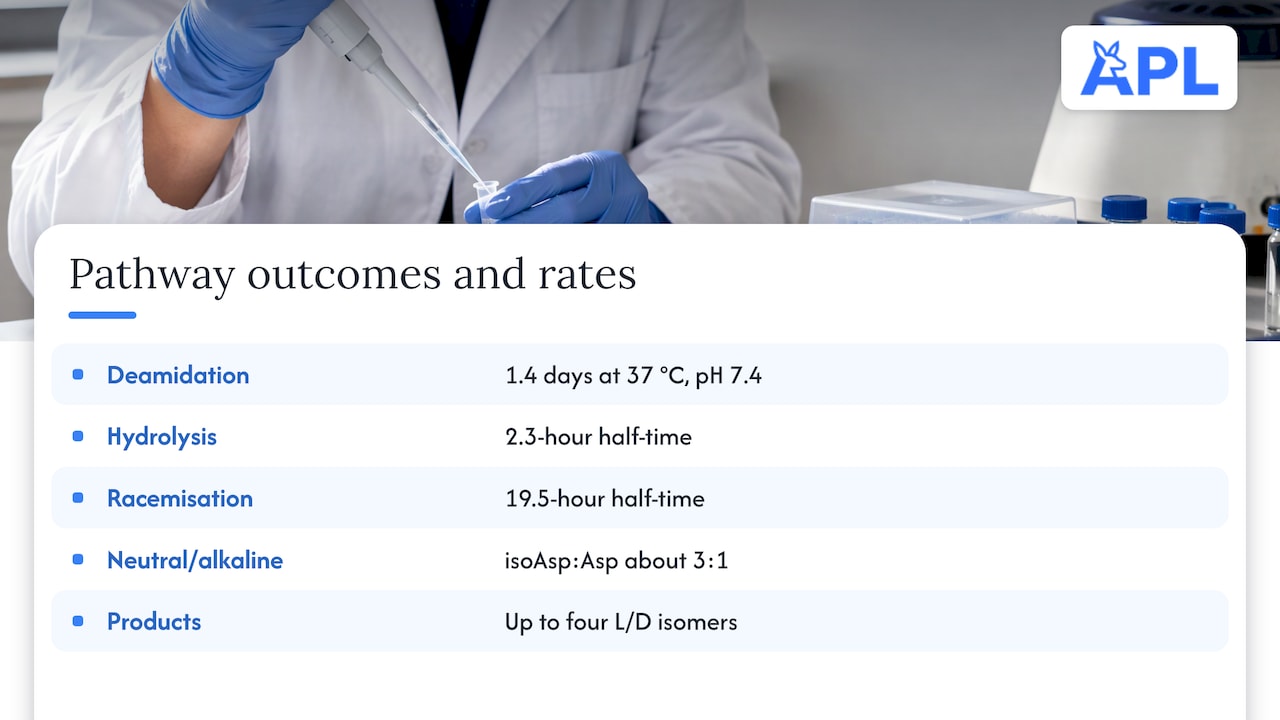
Under neutral and alkaline conditions, the backbone nitrogen of the residue following Asn attacks the side-chain carbonyl carbon. Ammonia is lost, and an aspartyl succinimide (Asu) ring forms. The ring is unstable in water and hydrolyses at either of its two carbonyls, giving two products: the normal Asp peptide, or the isoAsp peptide in which the chain continues through the side-chain carboxyl, adding a methylene group to the backbone.
In neutral and alkaline solutions, the isoAsp and Asp products form in a ratio of about 3:1, whereas in acidic solution the Asp peptide was the only deamidation product observed. This reflects a mechanistic change: at low pH, direct hydrolysis of the side-chain amide bypasses the cyclic intermediate and so cannot generate isoAsp.
The succinimide is also a branch point for racemisation. In a model hexapeptide containing an Asn-Gly sequence, deamidation at 37 °C and pH 7.4 had a half-life of 1.4 days, and the resulting succinimide reacted onward with half-times of 2.3 hours (hydrolysis) and 19.5 hours (racemisation). A single starting residue can therefore give rise to as many as four products (L-Asp, D-Asp, L-isoAsp and D-isoAsp), each with a different retention time, charge and potentially different activity.
Sequence and structure: why Asn-Gly is the hot spot
The residue on the carboxyl side of Asn controls how readily the backbone nitrogen can reach the side-chain carbonyl. In a study of pentapeptides with the sequences VSNXV and VXNSV, increasing size and branching of that neighbouring side chain slowed deamidation by as much as 70-fold relative to glycine. Glycine has no side chain, so cyclisation is sterically unobstructed.
Three-dimensional structure adds a second layer. Analysis of protein structures showed that only sterically unhindered Asn-Gly sequences have deamidation half-times of less than about 6 days, and most Asn-Gly sites in folded proteins react more slowly because the backbone is constrained. Short linear peptides lack that protection, which is why they often deamidate faster than the same sequence would inside a folded protein.
A working rule for sequence triage:
- Highest risk: Asn-Gly, followed by Asn-Ser and Asn-His, where the following residue is small or can assist the reaction.
- Moderate risk: Asn followed by Ala, Asp or Thr.
- Lower risk: Asn followed by bulky or beta-branched residues such as Val, Ile or Leu, and Gln in nearly all contexts.
These are qualitative tiers drawn from the sequence effects above; quantitative prediction models use the same inputs (neighbouring residues and structural flexibility) and should be validated against experimental data for the peptide in question.
Environmental factors that set the rate
Sequence determines the intrinsic susceptibility; the formulation and storage environment determine whether it is expressed.
pH and buffer
The succinimide route is base-catalysed, so rates climb as pH moves from acidic towards neutral and alkaline. Acid-catalysed direct hydrolysis operates in the opposite direction at very low pH. This is why a mildly acidic window is often selected for peptide solutions, a topic examined in the laboratory guide on peptide pH stability. Buffer species and ionic strength also matter: the rate depends on the buffer and ionic strength in model peptide work, so the choice of salts and additives is part of the stability design, as covered in the guide to peptide buffer selection.
Temperature
In a 2025 tandem mass spectrometry study of peptides, deamidation was pronounced at 60 °C, slower at 20 °C and negligible at 4 °C and −20 °C, including through freeze-thaw cycles. Temperature control is therefore the primary operational lever once a formulation is fixed. Transit and benchtop excursions are discussed in the decision guide on peptide temperature excursions.
Water availability
The reaction needs water. In the same study, nearly anhydrous 100% trifluoroacetic acid produced no detectable deamidation. This supports the long-standing practice of holding peptides as lyophilised powder with low residual moisture until solubilisation; the trade-offs are set out in the comparison of lyophilised and liquid peptides.
Summary of controlling factors
| Factor | Effect on Asn deamidation | Practical lever | | --- | --- | --- | | Following residue | Gly fastest; bulky residues slow it by up to 70-fold | Sequence review before synthesis or selection | | pH | Faster at neutral to alkaline pH via succinimide; Asp-only product at low pH | Select a validated mildly acidic window | | Temperature | Pronounced at 60 °C, negligible at 4 °C and −20 °C | Cold storage, minimal benchtop time | | Water | Required for the reaction | Store as lyophilised powder | | Buffer and ionic strength | Modulate the rate | Screen buffer species and salt concentration |
Consequences for structure, activity and quality
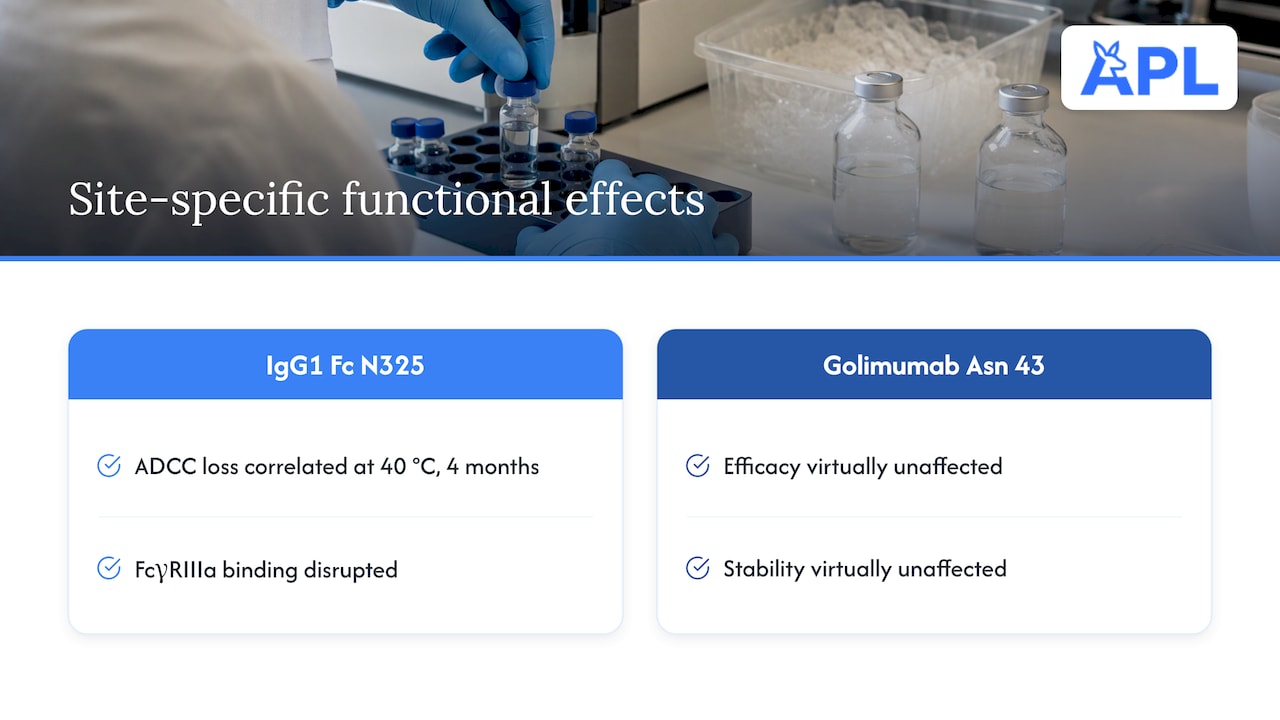
Deamidation does not have a uniform effect on function; the outcome is site-specific. The change in charge and the potential insertion of a methylene group into the backbone (isoAsp) can alter conformation, receptor binding, aggregation behaviour and immunogenicity.
In an IgG1 Fc study, deamidation at N325 correlated positively with loss of ADCC activity after heat stress (40 °C for 4 months), and surface plasmon resonance indicated disrupted binding to FcγRIIIa. In contrast, a study of one monoclonal antibody found that succinimide formation at Asn 43 had virtually no effect on efficacy or stability. Both findings are consistent: a modification in a binding interface matters, while one remote from it may not.
For a research laboratory, the relevant point is analytical rather than biological. A deamidated species is a distinct chemical entity. It co-elutes poorly with the parent peptide in some methods, shifts retention time in others, and, if unrecognised, appears as an impurity that reduces the apparent purity of a batch or as a confounder in a binding or cell-based assay. Purity values quoted on a certificate of analysis should always be read alongside the method used to generate them.
Detecting and characterising deamidation
Mass spectrometry is the principal tool. Deamidation converts an amide to a carboxylic acid, which adds a mass of about 0.984 Da (0.98402 Da). That shift is small, comparable with the spacing of the first isotopic peak of a peptide, so it demands adequate resolution and careful interpretation. Mass spectrometric methods allow rigorous site-specific characterisation of deamidation in therapeutic proteins and peptides, which matters because the modification can affect purity, stability, bioactivity and antigenicity.
Two cautions apply to interpretation:
- Intact mass alone cannot separate isoAsp from Asp. Both carry the same +0.984 Da shift, and because the pathways differ (succinimide-mediated versus direct hydrolysis), site-specific MS/MS readouts are needed to tell the isomers apart. Chromatographic separation, which commonly resolves isoAsp from Asp, complements the fragmentation data.
- Sample preparation can create the artefact being measured. In a multi-attribute method workflow, acidification with 1% TFA caused time-dependent deamidation during autosampler storage (up to 40 hours at 5 °C), while 1% formic acid or no acidification (pH 6.5) showed nearly no increase. The authors recommended avoiding harsh acidification and, where acid is needed, using milder conditions such as 1% formic acid, 0.1% TFA or 0.1% difluoroacetic acid.
A sensible analytical design therefore includes a freshly prepared control, a defined autosampler temperature and residence time, and an orthogonal chromatographic method alongside the MS data.
Limiting deamidation in preparation, handling and storage
The evidence above converts into a short, ordered procedure for laboratories handling peptide reference material.
- Review the sequence. Flag every Asn, prioritise Asn-Gly and Asn-Ser, and record the flags in the laboratory notebook or stability file.
- Hold the material as lyophilised powder at low temperature until the day of use. Negligible deamidation was observed at 4 °C and −20 °C in the study cited above, and water is a prerequisite for the reaction.
- Dissolve in a validated, mildly acidic buffer where the peptide's solubility permits. When a pH shift is needed to dissolve a peptide, the bench pH adjustment workflow describes how to make the change in controlled steps.
- Minimise time in solution at room temperature. Prepare aliquots under aseptic conditions, as described in the guide to aseptic bench peptide handling, and freeze single-use volumes rather than cycling one stock.
- Consider the counterion. Residual TFA from synthesis and purification is acidic and can influence solution pH; a validated counterion exchange is one way to control it.
- Verify condition on arrival. Shipping records and receipt checks, covered in the notes on 2–8 °C cold chain shipping, protect against excursions before the material reaches the bench. Where a laboratory runs many lots, a cold chain validation database turns individual observations into a stability record, and hot-weather shipping practice is worth reviewing for Australian summer dispatch.
- Re-test on a schedule. Re-run the MS and chromatographic method at defined intervals and compare against the baseline recorded at receipt.
Perspective: why stability data belongs on the purchasing checklist
We regard deamidation as the clearest illustration of why a purity percentage is a starting point for evaluation and not the end of it. A peptide that is 99% pure on the day of analysis can acquire a measurable deamidated fraction through storage, solubilisation or transit, and the resulting isoAsp and Asp species behave as distinct compounds in chromatography and in assays.
For that reason, our position is that research peptides should be supplied with batch-specific, third-party certificates of analysis, dispatched promptly, and handled by laboratories with a defined stability workflow. Local stock matters in this context: our consignments are dispatched from Melbourne within one business day, which removes customs dwell time from the sequence of events that can expose a lyophilised peptide to heat.
Laboratories that pair verified material, sequence-aware handling and orthogonal analytical confirmation are positioned to generate reproducible data, and that is the standard we build our range and our documentation around.
Au Peptide Labs editorial team
Sourcing documented research peptides in Australia
Laboratories planning a stability study can review the full range on the Au Peptide Labs store and select the category matching the sequence of interest. All products are for laboratory research only.
Frequently asked questions
Which amino acids undergo deamidation in peptides?
Asparagine is the main site, and glutamine deamidates much more slowly. In an aged human lens study, Asn deamidation was about three times that of Gln. Asn followed by glycine is the most reactive sequence.
Is deamidation the same as deamination?
No. Deamidation removes the side-chain amide of Asn or Gln and produces a carboxylic acid, with a mass increase of about 0.984 Da. Deamination removes an amino group, a different reaction, and the two terms are often confused in search results.
What is isoaspartate and why does it matter?
IsoAsp is the product formed when the succinimide intermediate hydrolyses on the side-chain carbonyl, so the backbone runs through the side-chain carboxyl. In neutral and alkaline solutions it forms at about three times the amount of Asp. It has the same mass as Asp, so MS/MS and chromatography are needed to distinguish them.
How should deamidation be minimised during storage?
Store peptides as lyophilised powder at low temperature, dissolve in a validated mildly acidic buffer, and limit time in solution. Negligible deamidation was reported at 4 °C and −20 °C in a 2025 peptide study, and single-use aliquots avoid repeated handling.
Sources
- Age-Dependent Deamidation of Lifelong Proteins in the Human Lens (IOVS, 2010)
- Effects of amino acid sequence, buffers and ionic strength on deamidation (JBC, 1991)
- Deamidation, isomerization and racemization at asparaginyl residues (JBC, 1987)
- Deamidation of Proteins and Peptides: Monograph 0001
- Protein deamidation (PNAS, 2001)
- Revealing deamidation and isoaspartate formation during peptide analysis (2025)
- Characterization of IgG1 Fc Deamidation at Asparagine 325
- Asu modification in a monoclonal antibody (Frontiers in Chemistry, 2022)
- Mass spectrometric analysis of asparagine deamidation
- Recent advances in mass spectrometric analysis of protein deamidation (2017)
- Addressing Acid-Catalyzed Deamidation and the Solubility of peptides in MAM workflows (2023)