
KPV (Lys-Pro-Val), formally designated as the C-terminal tripeptide fragment of α-melanocyte-stimulating hormone (α-MSH, residues 11–13), is a research-use compound with a well-characterised preclinical anti-inflammatory profile. It is supplied as research-grade material for laboratory research use only. Researchers procuring KPV domestically should prioritise suppliers offering a Certificate of Analysis (COA), reported purity of ≥98–99%, clear "for research use only" labelling, and same-country dispatch for shorter transit. Aupeptidelabs is one such domestic supplier, dispatching from Australia within one business day.
Quick-reference specifications:
- Sequence: Lys-Pro-Val (K-P-V)
- Molecular formula C₁₆H₃₀N₄O₄, molecular weight ≈342.44 g·mol⁻¹
- CAS No: 67727-97-3
- Physical form: lyophilised powder
- Common research pack sizes typically include small quantities suitable for laboratory research.
- Supply status: for laboratory research use only
What is the KPV peptide, and how does it work?
KPV is a synthetic tripeptide whose sequence corresponds to positions 11–13 of the 13-amino-acid melanocortin hormone α-MSH. Its chemical identity is registered on PubChem under CAS 67727-97-3, with molecular formula C₁₆H₃₀N₄O₄ and molecular weight ≈342.44 g·mol⁻¹. Despite being three amino acids in length, KPV retains most of α-MSH's anti-inflammatory activity while lacking the His-Phe-Arg-Trp "message" sequence responsible for melanocortin-receptor-driven pigmentation.
| Property | Value | | --- | --- | | Peptide name | KPV (Lys-Pro-Val; α-MSH 11–13) | | Molecular formula | C₁₆H₃₀N₄O₄ | | Molecular weight | ≈342.44 g·mol⁻¹ | | CAS number | 67727-97-3 | | Parent molecule | α-melanocyte-stimulating hormone (α-MSH) | | Physical form | Lyophilised powder | | Common pack size | 10 mg | | Typical purity (research grade) | ≥98–99% |
The mechanistic profile of KPV operates through two complementary pathways. First, KPV interacts with melanocortin receptors (MC1R, MC3R, MC5R) on immune and epithelial cells, engaging an endogenous anti-inflammatory signalling axis that dampens pro-inflammatory cytokine release. Second, and more distinctively, KPV enters intestinal epithelial cells via the PepT1 (SLC15A1) transporter, a proton-coupled oligopeptide transporter highly expressed in small intestinal mucosa and upregulated in inflamed colonic tissue. Once intracellular, KPV inhibits NF-κB nuclear translocation, reducing transcription of TNF-α, IL-1β, IL-6, and IFN-γ-driven genes. This intracellular mechanism is largely independent of surface receptor binding, which distinguishes KPV from simpler melanocortin agonists and explains its activity in cell types with low receptor expression.
In research settings, KPV is supplied as a lyophilised powder. Standard pack sizes for laboratory use are 10 mg vials, with research-grade suppliers reporting purity levels of ≥98–99% and providing batch COAs.
What does the preclinical evidence actually show?
The published literature on KPV is internally consistent and mechanistically well-characterised, but the evidence base is predominantly in vitro and rodent models. The published evidence base is predominantly in vitro and rodent models; researchers designing experiments with KPV should calibrate their expectations accordingly.
Established preclinical findings:
- Reduced colonic inflammation in dextran sulfate sodium (DSS) and TNBS-induced rodent colitis models
- NF-κB pathway inhibition demonstrated in intestinal epithelial cell lines (Caco-2-BBE), including suppression of IκB-α degradation
- PepT1-mediated uptake into intestinal epithelial cells, with PepT1 expression upregulated in inflamed colonic tissue, creating a built-in lesion-targeting mechanism
- Attenuation of pro-inflammatory cytokines (TNF-α, IL-1β, IL-6) in lipopolysaccharide-stimulated mouse models
- Reduced inflammatory markers in rodent skin-inflammation models
- Preliminary antimicrobial activity against Candida and Staphylococcus in vitro
A critical pharmacokinetic limitation governs all oral and systemic research designs. Free tripeptides are susceptible to rapid degradation by plasma and intestinal peptidases, and efficient PepT1 uptake in the proximal small intestine can mean KPV is absorbed or degraded before reaching an inflamed colon. This is precisely the problem that targeted nanoparticle delivery systems address: hyaluronic-acid-functionalised PLGA nanoparticles loaded with KPV demonstrated substantially higher colonic tissue concentrations and efficacy at lower KPV amounts than free peptide in DSS mouse models.
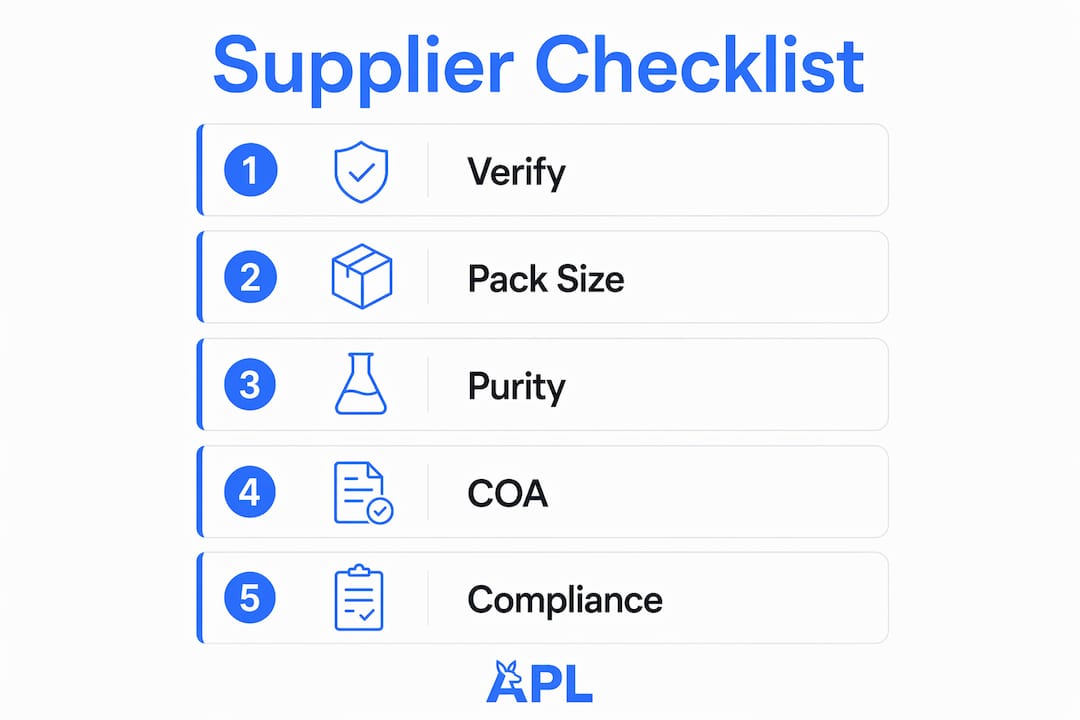
How to assess a KPV supplier: a practical checklist
Sourcing research-grade KPV in Australia requires systematic vendor assessment. The checklist below covers the minimum verification criteria; suppliers unable to satisfy these should be excluded from procurement consideration.
Core verification checklist:
- Certificate of Analysis (COA): batch-specific, not generic; must include HPLC and MS traces confirming identity and purity
- Reported purity: ≥98–99%; product listings from reputable Australian suppliers typically report purity at this level with COA download options
- Batch number and expiry date: traceable lot identification is non-negotiable for research records
- Storage instructions: lyophilised KPV requires −20 °C long-term; dissolved material requires 2–8 °C
- "For research use only" labelling: explicit on product, packaging, and documentation
- Third-party testing: COA issued by an independent analytical laboratory, not the supplier's in-house facility
- Domestic dispatch: Australian-origin shipments eliminate customs delays and reduce cold-chain risk; confirm dispatch timelines before ordering
Red flags that disqualify a supplier:
- No COA, or a COA without HPLC/MS data
- Vague purity claims ("high purity" without a stated percentage)
- Marketing language implying human therapeutic use
- Unverifiable laboratory address or no traceable contact details
- No lot-specific documentation
For researchers evaluating high-purity peptide sources in Australia, the comparison dimensions that matter most are pack size (typically 10 mg for KPV), purity percentage with COA verification, price per vial, shipping origin and estimated transit time, and stated storage requirements and shelf life. Domestic dispatch from an Australian-based supplier is the single most operationally significant factor for maintaining cold-chain integrity and avoiding customs-related delays.
| Dimension | What to verify | | --- | --- | | Pack size | 10 mg standard; confirm availability of custom or bulk quantities | | Purity (%) | ≥98–99% with batch-specific HPLC/MS COA | | Price per vial | Compare on a per-milligram basis, not per-vial sticker price | | Shipping origin | Domestic (Australia) preferred; overseas requires import assessment | | Dispatch time | Confirm business-day dispatch commitment | | Storage requirements | Lyophilised: −20 °C; dissolved: 2–8 °C | | Shelf life | Confirm from COA expiry; aliquot to extend working stock life |
Laboratory handling, storage and disposal of KPV
KPV is supplied as a lyophilised powder and is stable under appropriate conditions. The following guidance applies to research laboratory use; all handling must comply with institutional biosafety and hazardous waste protocols.
Storage of lyophilised material: Store at −20 °C for long-term stability, protected from light and moisture. Avoid repeated freeze-thaw cycles, which accelerate degradation of the peptide backbone. Aliquot material to avoid repeated freeze-thaw cycles.
Laboratory record-keeping standard: Every dissolved vial should be labelled with the lot number, solubilisation date, solvent used, concentration, and "for research use only." These records support both institutional compliance and experimental reproducibility.
Solutions: store at 2–8 °C per the supplier's stability data. Do not return unused dissolved material to the original vial.
Personal protective equipment and biosafety: Standard laboratory PPE (gloves, lab coat, eye protection) applies. Use a biosafety cabinet when handling dissolved peptide solutions in open vessels, consistent with institutional biosafety requirements.
Disposal of unused or expired KPV: Dispose of unused peptide material, dissolved solutions, and contaminated consumables in accordance with your institution's hazardous biological and chemical waste protocols. In Australia, this typically means segregation into labelled biohazard or chemical waste containers and collection by a licensed waste contractor under the relevant state environment protection legislation. Do not dispose of peptide solutions via the general drain without confirming institutional approval.
How Aupeptidelabs supports Australian KPV research
Aupeptidelabs supplies high-purity KPV peptide as a lyophilised research reagent, dispatched from Australia within one business day of order confirmation. Each batch is accompanied by a third-party Certificate of Analysis reporting purity levels of ≥99%, with HPLC and MS data available for researcher verification. All products carry explicit "for research use only" labelling and traceable lot numbers, supporting institutional chain-of-custody requirements.
The domestic fulfilment model is operationally significant for Australian laboratories. Shipments originating within Australia bypass the customs assessment process that applies to overseas consignments, reducing both transit time and the risk of cold-chain interruption. Discreet packaging is standard, and the customer satisfaction rating of 4.6/5 based on verified reviews reflects consistent fulfilment performance across the research community.
Research-grade KPV from Aupeptidelabs: ordering and compliance
Aupeptidelabs offers KPV as a 10 mg lyophilised vial with ≥99% reported purity and a batch-specific COA supplied with every order. Domestic dispatch within one business day from Australia means most researchers receive their order without the delays or import complications associated with overseas procurement.
Ordering is completed through the KPV product page on the Aupeptidelabs website. Bulk and custom order quantities are available on request via technical support. All products are strictly for laboratory research use and are not intended for human or veterinary administration. Researchers are advised to confirm institutional ethics or governance approval before procurement, retain the supplied COA and lot documentation, and store material in accordance with the cold-chain specifications provided.
For researchers evaluating the full range of research peptides available in Australia, Aupeptidelabs maintains an extensive inventory with consistent purity standards and domestic fulfilment across all product lines. Contact technical support directly for research pack pricing, bulk quantities, or specific formulation enquiries.
An editorial perspective on sourcing and evidence standards
The gap between community enthusiasm for KPV and the actual state of the human evidence is wider than most online commentary acknowledges. The preclinical literature is genuinely interesting: the PepT1-mediated intracellular mechanism is well-characterised, the rodent colitis data is consistent, and the nanoparticle delivery work demonstrates that the compound can be made to work efficiently in targeted formulations.
The practical implication for Australian researchers is straightforward. KPV is a legitimate and well-sourced research reagent with a defensible mechanistic rationale for gut-inflammation and skin-inflammation experimental models.
Where sourcing decisions intersect with evidence quality, the COA is the minimum threshold, not the ceiling. Researchers should treat third-party HPLC and MS verification as standard, not optional, and should prefer domestic suppliers who can provide traceable lot documentation. The operational advantages of Australian-origin dispatch, reduced customs risk and preserved cold-chain integrity, are not trivial considerations when experimental reproducibility depends on material quality at the point of use.
Useful sources and regulatory references
The following primary sources and regulatory references support the claims in this article and provide a starting point for further literature review and compliance verification.
| Source | Type | Key content | | --- | --- | --- | | PubChem: KPV (MSH 11-13) | Chemical registry | Molecular formula, MW, CAS number, structural data | | Dalmasso et al. — PepT1 transport study (PubMed) | Primary research | PepT1-mediated KPV uptake in intestinal epithelial cells; Kₜ characterisation | | Xiao et al. — HA-KPV-NP/hydrogel (PMC) | Primary research | Nanoparticle-targeted KPV delivery in a DSS mouse model |
How to use these sources in experimental design: The PubChem entry provides the chemical identity data required for reagent documentation. The Dalmasso PepT1 study and the Xiao nanoparticle paper are the two most-cited mechanistic references for gut-targeted KPV research and should be included in any literature review for intestinal inflammation models.