How do I verify the COA?
Every batch is independently tested by Janoshik Analytical. Each product links straight to the lab's own record, so you can check the exact purity figure yourself before you buy — nothing to take on trust.
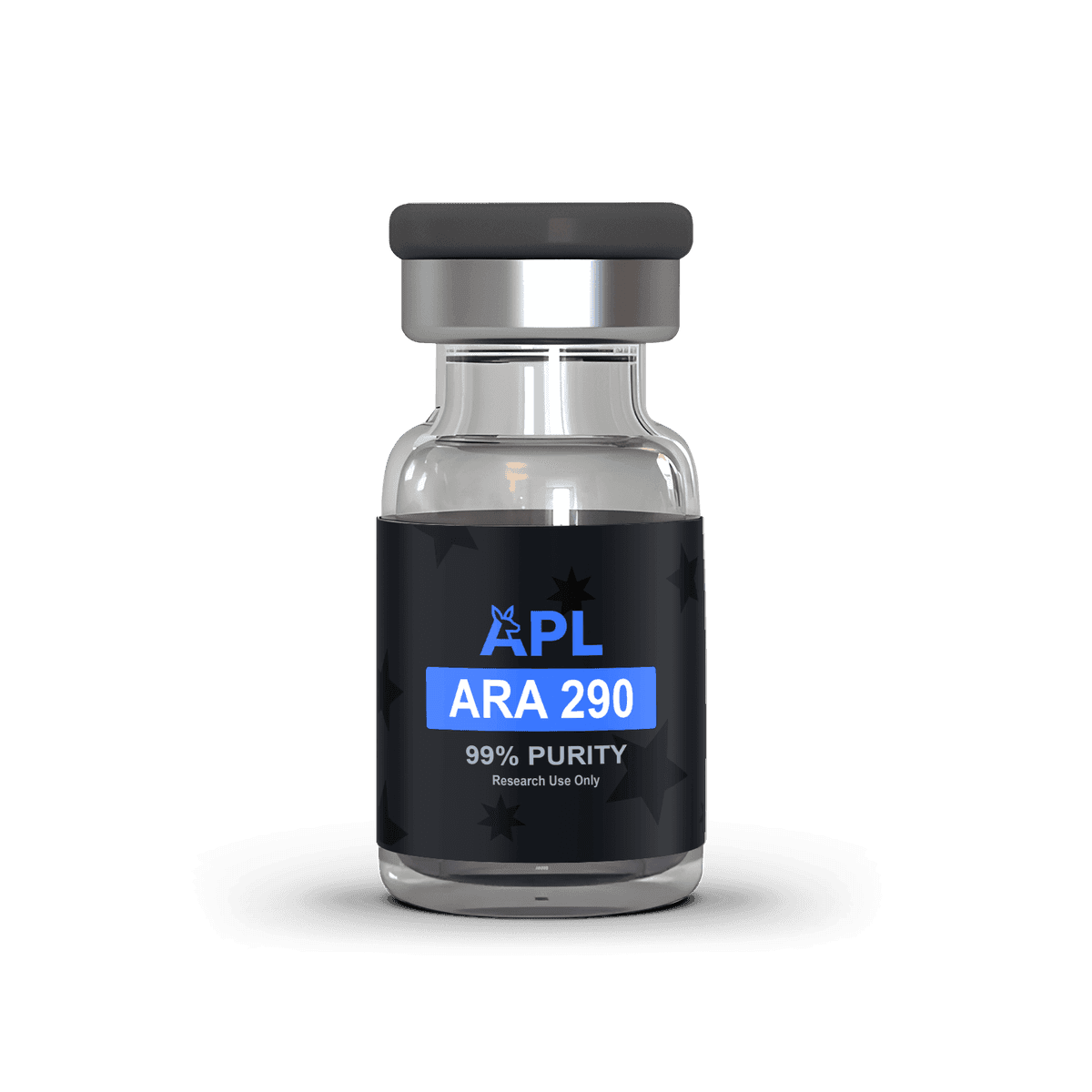
Format
Sealed research vial
Trust signal
COA-backed inventory
A$89.99
Select options below
Size
Select one
Select your preferred options to continue.
Fast AU dispatch, tracked delivery, and documentation-ready inventory.
Why labs buy from APL
High purity, consistent supply, and fast AU-wide dispatch.
Certificate of Analysis
COA library
Browse the current COA library and available product documentation.
Structural class
ARA 290 is a non-hematopoietic cyclic peptide (11 residues) derived from the helix B surface of erythropoietin (EPO) that selectively engages the innate repair receptor (IRR) — a heterodimer of the β-common receptor (βcR) and the EPO receptor (EPOR).
Pathways studied
ARA 290 reproduces the tissue-protective signalling of erythropoietin without binding the homodimeric EPOR complex responsible for haematopoiesis, enabling research into EPO's non-erythropoietic functions. The β-common receptor (CD131)/EPOR heterodimer (IRR) activates PI3K/Akt and MAPK signalling pathways upon ARA 290 binding, producing anti-inflammatory, anti-apoptotic, and neuro-protective readouts in relevant cell models. Because it does not engage the canonical EPOR homodimer, it can be used in haematopoietic models without confounding red cell lineage effects.
Typical research focus
ARA 290 is particularly valuable in experiments designed to separate EPO's tissue-protective functions from its erythropoietic actions. Research designs typically include full EPO, ARA 290, and IRR-selective antagonists as comparative conditions to attribute specific readouts to each receptor complex.
For laboratory research use only. Not for human or veterinary use, and not for human consumption. Intended for in-vitro and pre-clinical research settings only.
How to read a certificate of analysis, what purity actually measures, and how research peptides are stored and independently verified.
The questions researchers ask most.
Every batch is independently tested by Janoshik Analytical. Each product links straight to the lab's own record, so you can check the exact purity figure yourself before you buy — nothing to take on trust.
Keep vials sealed, dry, and out of direct light. Lyophilised (freeze-dried) peptides are stable at -20 °C; once reconstituted, store as noted on the product label. Full handling notes sit on every product page.
Order by 2pm for same-day dispatch from our Melbourne warehouse, otherwise the next business day, with tracked delivery Australia-wide. No customs, no border delays — it's already in the country.
More in the full FAQ · Rated 4.6★ on Trustpilot
Researchers who bought ARA 290 also stock these.
It brings together 1 labelled variant: 10mg, current pricing context, stock visibility, COA access, and internal links to related catalogue pages so a laboratory buyer can review the material from a single reference URL.
ARA 290 is generally discussed as a non-hematopoietic cyclic peptide (11 residues) derived from the helix B surface of erythropoietin (EPO) that selectively engages the innate repair receptor (IRR) — a heterodimer of the β-common receptor (βcR) and the EPO receptor (EPOR). The most relevant background is sequence behaviour, pathway or receptor context where documented, and analytical consistency under controlled laboratory conditions.
Use the label, COA, and internal SOPs as the primary guide. In general, store the material under controlled laboratory conditions, minimise avoidable environmental exposure, and keep variant tracking records current.
This page links the broader COA library when a product-specific document is not attached. Laboratories should use the published documentation set that is currently available for the listing.
No. The page should be interpreted strictly in a research and laboratory context. It does not provide dosage guidance, treatment claims, or human or animal use instructions.