
Three forces define peptide research in 2026: generative AI now compresses candidate discovery timelines, analytical expectations have moved well past a single purity figure, and manufacturing techniques for cyclic and non‑canonical residues are reshaping what labs can realistically order. The one action that matters immediately: demand batch‑specific third‑party certificates of analysis and orthogonal analytical data from every supplier before you place your order.
Au Peptide Labs supplies research peptides for laboratory research use only, each batch independently tested with a certificate of analysis.
The main technical and market trends shaping peptide research in 2026
Peptide research has shifted from a niche synthetic chemistry problem to a data‑driven discipline, and the pace of change is visible in three areas at once.
Generative models and high‑throughput screening now compress the discovery phase that used to take months of manual trial and error. Reviews of AI‑assisted peptide design describe predictive modelling replacing much of the guesswork in sequence selection, though the same reviews are blunt about the catch: model output is only as reliable as the training data and validated reference standards behind it.
Manufacturing has moved too. Cyclisation chemistry and non‑canonical amino acid incorporation are no longer specialist curiosities; they're turning up in standard catalogue offerings because they improve stability and target selectivity. That changes what a purchasing officer needs to ask a supplier, because a cyclic or modified peptide behaves differently under mass spectrometry than a linear one.
Market activity is also intensifying, and that has a direct downstream effect on quality control. A scalable reinforcement‑learning approach recently screened 36 million helical sequences and validated top candidates in vitro, evidence that computational screening at this scale is now practical, but it still leaves the wet‑lab validation step non‑negotiable.
For a lab evaluating this landscape, three things are worth tracking as you plan 2026 procurement:
- AI‑assisted design is shortening candidate identification but not replacing experimental confirmation.
- Structurally complex peptides (cyclic, branched, non‑canonical) are becoming standard catalogue items, not exceptions.
- Rising demand is putting pressure on suppliers' QC capacity, which makes supplier vetting more important, not less.
What does modern peptide characterisation require beyond a purity percentage?
A single purity percentage on a certificate tells you almost nothing about what's actually in the vial. Isobaric and near‑isobaric impurities, species with nearly identical mass to the target peptide, can sit undetected beneath one aggregate number, and industry analysis of current peptide QC practice is explicit that high‑resolution accurate‑mass mass spectrometry (HRAM‑MS) coupled with UHPLC separation is now the baseline expectation, not an upgrade.
Fragmentation method matters as much as resolution. Structure‑aware fragment assignment work published in Analyst shows that complementary activation techniques, particularly ETD and EThcD alongside standard HCD, resolve sequence ambiguities in modified and cyclic peptides that a single fragmentation mode misses.
A genuinely useful COA should give you more than a number. Look for:
- Raw spectral data, not just a summary chromatogram.
- A stated method summary (instrument, column, gradient, activation mode).
- Batch number tied specifically to the vial you received.
- Orthogonal confirmation, circular dichroism for secondary structure, NMR, or SEC‑MS for aggregation state.
Pro Tip: If a supplier can only offer you a purity percentage and no raw spectra, treat that as an incomplete answer, not a final one, and follow up before you order.
Proficiency testing data backs this up: an RCPAQAP pilot programme found real variability across labs detecting and quantifying peptides by mass spectrometry, which is a strong argument for demanding calibration transparency rather than assuming instrument output is automatically comparable across suppliers.
How is AI changing peptide discovery for labs ordering custom sequences?
Generative AI is genuinely accelerating candidate generation, but the practical implications for a lab placing an order are narrower than the hype suggests. Model‑driven design depends entirely on the quality of the sequences and structural data it was trained on, and the same limitation that slows drug development pipelines applies just as much to a research lab ordering a novel construct: garbage input produces confidently wrong output.
If you're ordering a novel or custom sequence in 2026, the practical checklist looks like this:
- Ask for evidence of synthesis fidelity specific to that sequence, not a generic company‑wide average.
- Request a validated stable isotope‑labelled (SIS) reference standard where quantitative work is planned.
- Confirm whether the supplier's synthesis and analytical validation sit in one integrated pipeline or are outsourced separately, since the latter tends to add weeks to turnaround.
Suppliers with synthesis and validation under one roof consistently cut time‑to‑result, because there's no shipping delay between production and the QC step that confirms what actually landed in the vial.
What should a lab's peptide procurement checklist include in 2026?
Run every prospective order through this sequence before you commit funds:
- Request the batch‑specific COA, including raw spectra and a stated analytical method, not a generic product sheet.
- Confirm stability data and recommended storage conditions are included, along with batch traceability back to synthesis records.
- Check domestic dispatch timeframes, discreet packaging.
- Ask what analytical methods and acceptance criteria were used, and request labelled reference standards for quantitative work.
- Watch for red flags: a single purity number with no supporting data, vague labelling.
Pro Tip: Keep a standing checklist in your procurement system so every order gets the same documentation review, regardless of who's placing it or how urgent the timeline feels.
Suppliers who can't produce third‑party testing documentation on request are telling you something about their QC capacity, whether they mean to or not.
Au Peptide Labs editorial team's perspective: turning 2026's trends into working procurement practice
The technology conversation around peptide research keeps racing ahead of quality assurance, and that gap is where institutional risk lives. My practical roadmap for a lab starting this quarter: first, stop accepting a bare purity percentage and insist on raw spectral data with every order. Second, formalise a supplier documentation checklist and apply it uniformly, including to suppliers you already trust. Third, budget time for orthogonal validation, don't expect AI‑accelerated candidate design to shorten your own in‑house confirmation work. None of this happens overnight; expect incremental gains across a quarter, not a single fix.
— Au Peptide Labs editorial team
How Au Peptide Labs supports compliant procurement in 2026
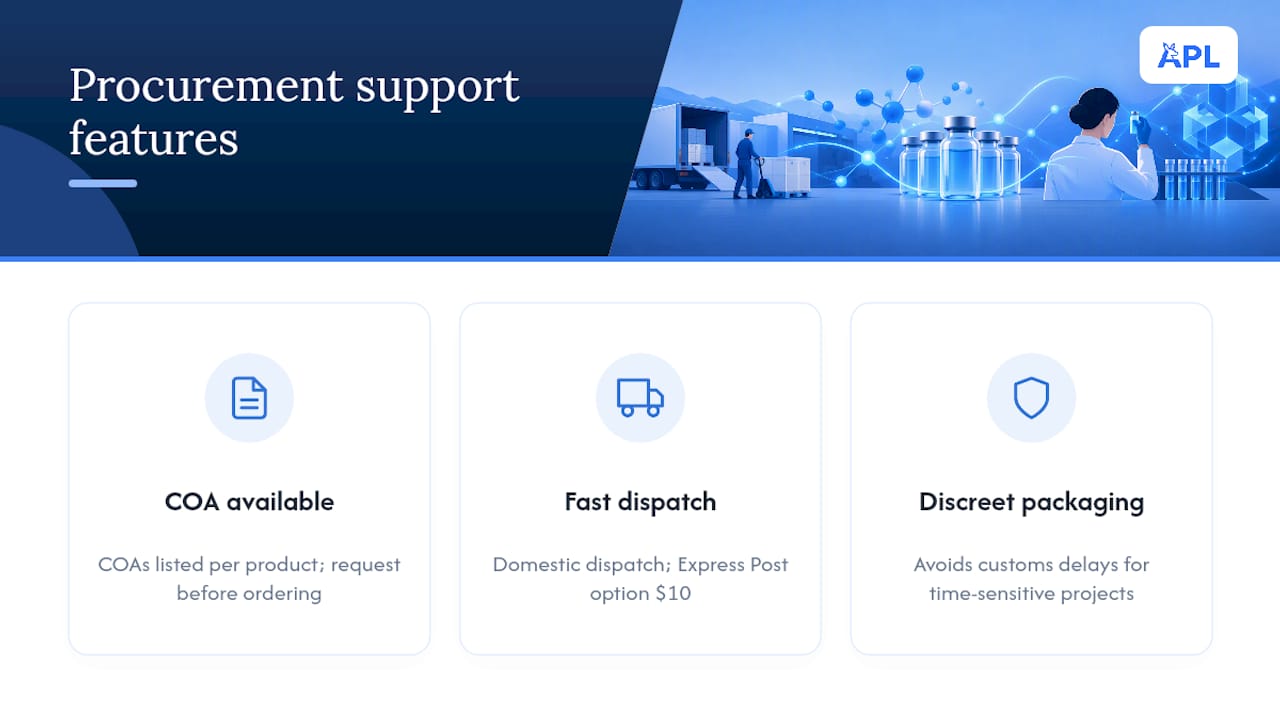
Some suppliers address procurement pressures by providing third‑party certificates of analysis with high purity, domestic dispatch within a short timeframe, and discreet packaging that avoids customs delays.
That combination suits two situations particularly well: time‑sensitive projects where a delayed shipment stalls an entire experimental timeline, and institutions that need documented batch traceability for audit or compliance review. Some providers report high customer satisfaction ratings based on verified reviews, though such figures are typically provided by the suppliers themselves rather than from independent benchmarks.
Primary sources and further reading
Verify claims directly against recent analytical reviews on AI‑driven peptide design, and proficiency testing summaries for peptide MS quality assurance. Labs sourcing calibrated reagents for orthogonal controls can also review ABMIUM's research reagent catalogue.
Sources
- Peptides and amino acids in drug development: where we stand and where we must go
- The new reality of peptide analysis
- A scalable reinforcement learning approach for screening large peptide libraries for bioactive peptide discovery
- Structure-aware fragment assignment for interpreting tandem mass spectrometry of modified and cyclic peptides
FAQ
What are the biggest peptide trends for 2026?
The dominant trends are AI‑assisted peptide design accelerating discovery, HRAM‑MS becoming the standard for analytical confidence. Manufacturing advances in cyclic and non‑canonical peptides are also changing what labs can order as standard catalogue items.
Is a purity percentage enough to judge peptide quality?
No. A single purity figure can hide isobaric impurities that only show up under high‑resolution mass spectrometry and complementary fragmentation methods like ETD or EThcD. Request raw spectral data and a method summary alongside any purity claim.
How fast does Aupeptidelabs dispatch peptide orders?
Some suppliers dispatch orders domestically within a short timeframe to avoid customs delays. Express shipping options may also be offered; current prices are listed on the pricing page of the supplier's website.
What should I ask a supplier before ordering a custom or novel peptide sequence?
Ask for synthesis fidelity evidence specific to that sequence, a validated stable isotope‑labelled reference standard if you need quantitative results, and confirmation that synthesis and analytical validation happen within an integrated pipeline. Suppliers without this documentation typically add weeks to your validation timeline.