
Metal contamination in peptides means trace elements such as arsenic, cadmium, mercury, lead or residual catalyst metals that are present in a peptide material without being part of its design. These elemental impurities are not detected by a standard HPLC purity figure, because HPLC measures peptide-related organic species, not elements. They are controlled through risk assessment of the manufacturing route and through dedicated elemental analysis. For research laboratories, the practical answer is to source peptides from a supplier that dispatches from within Australia, releases each batch with a third-party certificate of analysis (COA), and to read that certificate for exactly which analytes it reports. Au Peptide Labs supplies research-grade peptides on that basis, stocked in Australia and dispatched from Melbourne.
This article explains which metals are relevant, how they enter a peptide product, which limits regulators use as a reference, how the testing works and how a laboratory buyer should read the documentation. All peptides discussed here are for laboratory research only, and nothing below describes human or veterinary use.
Au Peptide Labs supplies research peptides for laboratory research use only, each batch independently tested with a certificate of analysis.
What metal contamination in a peptide product means
A peptide is an organic molecule, so any metal found in a vial is an impurity or an intentional component of a metal-complexed peptide. The term "elemental impurities" is used in pharmaceutical quality guidance for trace metals and metalloids that carry no therapeutic benefit. The reference framework is the ICH Q3D guideline, which sorts elements into classes by toxicity and likelihood of occurrence.
The ICH Q3D guideline places arsenic, cadmium, mercury and lead in class 1, the human toxicants that must be considered in every risk assessment regardless of source or route. Cobalt, nickel and vanadium sit in class 2A. Palladium and platinum are among the class 2B elements, which matter mainly when they are deliberately added, for example as catalysts. Copper and chromium are class 3.
For peptide work, three groups are most relevant:
- Class 1 toxicants (arsenic, cadmium, mercury, lead): usually arrive through raw materials, reagents, water or equipment, not through the peptide chemistry itself.
- Catalyst and reagent metals (palladium, platinum, nickel, cobalt, among others): relevant where a synthesis or modification step uses a metal-mediated reaction.
- Equipment and container metals (chromium, nickel, copper, iron): relevant where product contacts stainless steel, filters, stoppers or closures.
The word "heavy metals" is common in popular writing but is not the regulatory term. Guidance now speaks of specific elements with specific exposure limits, which is a more useful basis for any laboratory decision.
How metals enter peptide products
Solid-phase peptide synthesis, the common manufacturing route, builds the chain on a resin through repeated coupling and deprotection cycles, followed by cleavage, precipitation, purification and lyophilisation. Each stage offers a contamination pathway.
ICH Q3D identifies residual metal catalysts or reagents from manufacture, and elements leached from container closure components, among the potential sources of elemental impurities, which may arise during manufacture or storage.
In practical terms the pathways are:
- Raw materials. Amino acid derivatives, resins, solvents and cleavage reagents can carry trace metals from their own production.
- Catalysts and reagents. Metal-mediated steps, such as certain cyclisation, ligation or cross-coupling reactions, leave residues that purification must remove.
- Process equipment. Reactor vessels, tubing, pumps and chromatography hardware can shed metal ions, particularly under acidic conditions such as trifluoroacetic acid cleavage.
- Water and buffers. Purification and solubilisation water of insufficient grade introduces dissolved metals.
- Container closure systems. Vials, stoppers and caps may leach extractable species into the product over time. The topic is covered in depth in our note on Extractables and Leachables: Thresholds, Study Design and Testing.
- Handling. Metal spatulas, non-certified labware and unclean surfaces during weighing, aliquoting or dilution add contamination after release.
The last point deserves emphasis for laboratories. A batch that leaves the manufacturer within specification can still be compromised at the bench, which is why handling controls and appropriate diluents form part of any quality routine. Our peptide quality checklist and receipt checks set out the verification steps at intake.
Why HPLC purity does not describe metal content
A purity figure of 99% or more, as reported for the peptides we supply, describes the proportion of the target peptide relative to other peptide-related species detected by reversed-phase HPLC with UV detection. It is a measure of organic purity. Metals do not absorb at the wavelengths used for peptide bonds in a way that would register as a peak, and inorganic ions elute in or near the void volume.
This is also why purity and net peptide content are different quantities. A lyophilised powder contains the peptide, counterions such as trifluoroacetate or acetate, and residual water. The net peptide content glossary entry explains how that composition affects the mass of active peptide in a vial. Counterion management is addressed separately in our article on counterion exchange. For a detailed account of impurity classes, see peptide impurities: types, origins and detection.
ICH Q3A and Q3B exclude synthetic peptides from their scope, although their principles remain relevant to peptide-related impurities. Elemental impurities fall under the separate Q3D framework.
How metal contaminants are tested
Elemental analysis of pharmaceutical materials relies on plasma-based spectrometry. USP chapter 233 describes two primary procedures: inductively coupled plasma optical emission spectroscopy (ICP-OES) and inductively coupled plasma mass spectrometry (ICP-MS). ICP-MS offers the lower detection limits and handles complex sample matrices, which makes it the usual choice for trace-level class 1 elements.
The workflow typically runs as follows:
- Sample preparation. The peptide powder is digested, commonly with high-purity acid, using closed-vessel microwave digestion, or dissolved in a suitable solvent where the method permits.
- Instrument calibration. Multi-element standards at known concentrations establish the response for each target element, with internal standards correcting for drift.
- Measurement. The digest is introduced as an aerosol into the plasma, and ions are separated by mass-to-charge ratio.
- Quality controls. Blanks, spiked recoveries and reference materials confirm that the result is not an artefact of reagents or matrix suppression.
- Reporting. Results are expressed as a concentration, for example micrograms per gram of material, together with the limit of quantitation for each element.
A more general overview of analytical techniques used on peptides, including identity and purity methods, is available on our laboratory testing methods page.
Reading limits correctly: concentration versus daily exposure
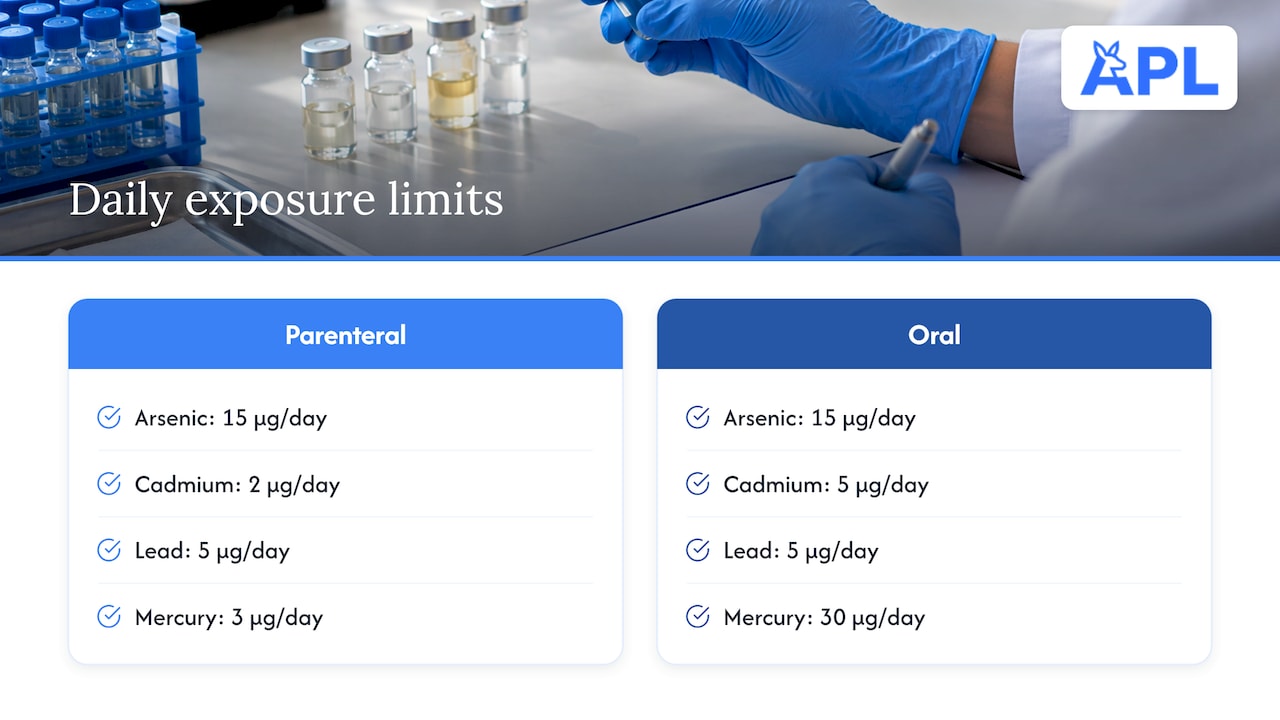
Quoted limits are frequently misapplied. ICH Q3D defines permitted daily exposures (PDEs), which are amounts of an element per day by a given route, not concentrations in a powder. In the guideline, the parenteral and oral PDEs are, respectively, 15 and 15 µg/day for arsenic, 2 and 5 µg/day for cadmium, 5 and 5 µg/day for lead, and 3 and 30 µg/day for mercury, as set out in the Q3D text. The guideline applies these with consideration of route and daily dose, so a concentration result alone cannot show whether a medicinal product meets an exposure-based limit.
A worked illustration of the logic, without implying any dose for a research material: a limit expressed as micrograms per day converts to a concentration limit only once the maximum daily amount of the material is defined. A larger assumed daily amount lowers the concentration that can be tolerated. Pharmaceutical developers fix that denominator in the product specification, whereas a research material has no clinical dose, so the PDE framework serves as a benchmark for assessing risk, not a pass or fail threshold for a research reagent.
ICH Q3D(R2) is the current version of the guideline. For pharmaceutical companies exploring peptide applications, it is the reference for building an elemental impurity risk assessment, covering every potential source from drug substance to container closure.
Reading a certificate of analysis for elemental information
A COA is a batch-specific document. When reviewing one, work through the following points in order:
- Batch and lot number. The number on the COA must match the vial label exactly. A generic or undated certificate describes no particular batch.
- Identity. Mass spectrometry confirming the molecular weight against the theoretical value.
- Purity. The HPLC method, wavelength and the reported percentage, ideally with the chromatogram.
- Content. Net peptide content, where reported, since it determines how much peptide a weighed mass contains.
- Elemental analysis. Which elements are reported, by which technique (ICP-MS or ICP-OES), with what reporting limits. A result of "not detected" is meaningful only alongside the limit of quantitation.
- Testing party. Whether the analysis was carried out by an independent laboratory, and the date of analysis.
- Microbial and endotoxin data. Relevant to sterility-sensitive work; see the sterility checklist.
For research use the useful question is whether the documentation supports your assay. A cell-based experiment sensitive to divalent cations, or a metalloenzyme study, will have different tolerance for trace nickel, copper or zinc than a binding assay run in a chelating buffer. Define the tolerance first, then read the certificate against it.
Controlling contamination at the bench
Supplier documentation addresses the product as released. The following practices protect it once it is in the laboratory.
- Use appropriate water. Use solvent and water grades suitable for the analytical application.
- Avoid metal contact. Use plastic or ceramic spatulas, and low-binding polypropylene tubes where adsorption is a concern.
- Segregate and label. Aliquot to limit repeated opening, and record the lot number on every aliquot.
- Store as specified. Lyophilised material is generally stored cold and protected from moisture and light, and dissolved material is handled according to the validated stability window for the assay.
- Calculate accurately.
- Check for particles. Visible or subvisible particulates may signal container-derived contamination; the subvisible particles article explains why particle counts alone may not identify the material.
Our perspective
Metal contamination is a documentation question before it is an analytical one. A purity percentage answers how much of a sample is the intended peptide, and it leaves the elemental profile undescribed. Laboratories are best served by suppliers whose batches carry independent third-party testing and a verifiable COA for every lot, so that each result can be traced to the vial on the bench.
We hold that sourcing within Australia removes a variable that is easy to overlook. Our shipments are dispatched from Melbourne, within one business day, so material does not pass through customs and its chain of custody is shorter. Our peptides are independently tested to 99%+ purity, and every batch is released with a certificate that can be verified.
The research community is better served by precise language than by marketing language. Our products are supplied strictly for laboratory research, and we describe them that way: as reagents with documented identity and purity, handled under controls that protect the integrity of the experiment.
Au Peptide Labs editorial team
Sourcing research peptides with documented batches
All products are for laboratory research only, not for human or veterinary use. The landing page lists the full range.
Frequently asked questions
Which metals are most relevant in peptide products?
Arsenic, cadmium, mercury and lead are the class 1 elements in ICH Q3D and must be considered in any risk assessment. Catalyst metals such as palladium and nickel matter where a synthesis step uses them, and container or equipment metals such as chromium and copper matter where product contacts those materials.
Does a 99% purity result mean a peptide is free of metals?
No. HPLC purity measures peptide-related organic species, not elements. Metal content is measured separately, typically by ICP-MS or ICP-OES, and is reported element by element with a limit of quantitation.