
Peptides are not classified as dangerous goods as a category in Australia. Classification depends on the specific product: its identity, concentration, formulation and any solvent or additive. The Australian Dangerous Goods Code (ADG Code) requires the actual hazardous properties of an unnamed substance to be determined before any entry is selected, and the safety data sheet (SDS) for the product records the result in Section 14. Au Peptide Labs supplies research peptides from Melbourne, and this article sets out how the classification logic works so that laboratories, procurement officers and informed readers can read a transport classification correctly.
The article covers the nine classes, the classes that can plausibly be relevant to a peptide shipment, the documentation that follows from a classification, and the rule changes that apply today. All products discussed by Au Peptide Labs are supplied strictly for laboratory research, and are not for human or veterinary use.
Au Peptide Labs supplies research peptides for laboratory research use only, each batch independently tested with a certificate of analysis.
What the ADG Code is and which edition applies
The ADG Code is the Australian technical standard for the land transport of dangerous goods, maintained by the National Transport Commission (NTC) and given legal force through state and territory legislation. It sets out how substances are classified, packed, marked, labelled and documented.
According to the NTC's page on the Code, Edition 7.9 is the latest edition. It could be used from 1 October 2024 and became mandatory from 1 October 2025, although some states had a later commencement date for optional use. Any classification prepared against an earlier edition should therefore be checked against Edition 7.9, and a supplier's SDS should reference the edition in force.
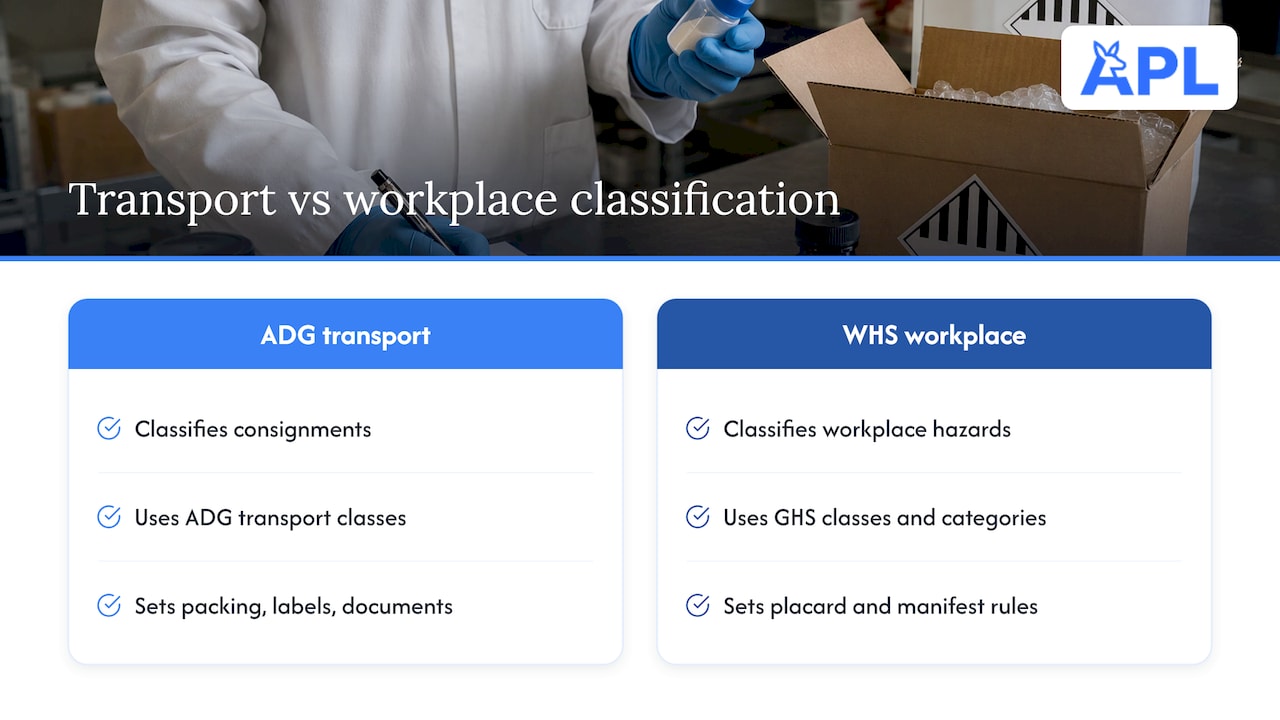
A distinction matters for laboratories that store as well as receive material. Transport classification under the ADG Code is separate from workplace classification under the work health and safety (WHS) regulations. Safe Work Australia's placard and manifest guidance states that WHS placard and manifest requirements use GHS hazard classes and categories, not ADG transport classes. A product can therefore carry a transport class on a consignment note while its storage obligations in a laboratory are determined by a different system.
The nine classes and the packing groups
The Australian system uses nine classes of dangerous goods. The Civil Aviation Safety Authority's summary of classes and hazard labels describes each class by its main hazard, and each class is shown by a coloured, diamond-shaped label.
| Class | Main hazard | | --- | --- | | 1 | Explosives | | 2 | Gases | | 3 | Flammable liquids | | 4 | Flammable solids, substances liable to spontaneous combustion, and substances that emit flammable gases when wet (Division 4.3) | | 5 | Oxidising substances and organic peroxides | | 6 | Toxic substances (6.1) and infectious substances (6.2) | | 7 | Radioactive material | | 8 | Corrosive substances | | 9 | Miscellaneous dangerous substances and articles |
The NTC's draft Part 2 of the revised Code states that Division 4.3 applies to substances that emit flammable gases in contact with water. It also explains that Packing Groups I, II and III represent high, medium and low danger respectively. A packing group is assigned within a class according to the degree of danger, and it determines the packaging standard required.
The nine-class table answers the general question. For peptides, the practical question is narrower: which of these classes, if any, a particular product meets.
Why a peptide is not automatically dangerous goods
A peptide is a short chain of amino acids. Many research peptides are supplied as a lyophilised (freeze-dried) powder in a sealed vial, in milligram quantities. Nothing in the nine-class structure assigns "peptide" to a class. The ADG Code operates on named entries and generic entries:
- Where a substance has its own named entry in the Code, that entry is used.
- Where it does not, the consignor must establish the substance's dangerous properties and then choose the most specific generic or not-otherwise-specified entry that fits.
- Where the properties do not meet the criteria of any class, the substance is not dangerous goods for transport purposes.
This follows the structure of ADG Code Volume I, Edition 7.9, which is why a blanket statement that peptides are dangerous goods, or that they are exempt, would be incorrect. The determination is made per product.
The NTC draft Part 2 adds that unnamed substances, including solutions and mixtures, are classified according to their degree of danger and their physical, chemical and physiological properties. Safe Work Australia's national guide to classifying hazardous chemicals adds a rule relevant to formulated products: test data for a mixture should take precedence over calculations based on its ingredients.
Properties that drive the outcome
For a peptide product, the following inputs determine the result:
- The peptide itself. Its toxicological data, where available, indicate whether it could meet Class 6.1 criteria.
- Physical form. A lyophilised solid and a solution are assessed differently.
- Solvent or diluent. A flammable solvent could introduce Class 3 properties, and a corrosive or acidic component could introduce Class 8 properties.
- Additives and residual reagents. Counter-ions and excipients are assessed as part of a mixture, not ignored.
- Quantity per inner and outer package. Quantity determines whether limited-quantity provisions can apply.
Certificate of analysis (COA) data on purity describes the composition of the peptide batch. It supports the identification step, but it is not itself a transport classification, which is a separate determination recorded in the SDS.
Classes that can apply to a peptide shipment
The research on Australian guidance identifies the following classes as the ones worth testing a peptide against.
Class 6.1: toxic substances
The NTC draft Part 2 defines Class 6.1 substances as those capable, in relatively small quantities, of causing damage to human health or death by inhalation, skin absorption or ingestion. Packing Group I, II or III is assigned according to the degree of danger. A peptide would enter this class only if its toxicity data meet those criteria. Many peptides lack comprehensive toxicological datasets, which is why the next principle in the SDS rules matters.
Division 6.2: infectious substances
CASA describes Division 6.2 as covering infectious substances that contain, or are expected to contain, pathogens capable of causing disease in humans or animals. A synthetic peptide is a chemical manufactured by solid-phase or solution-phase synthesis and is not a pathogen. Division 6.2 becomes relevant to laboratories mainly when peptides are shipped as components of biological samples, such as a peptide in a preparation with cell material, which is a different consignment from a catalogue research peptide.
Classes 3, 8 and 9
The Northern Territory's WorkSafe guidance on transporting dangerous goods confirms that dangerous goods are classified under the ADG Code, and lists classes such as Class 3 for flammable liquids, Class 8 for corrosive substances and Class 9 for miscellaneous dangerous substances. These can apply where a particular formulation meets those criteria, for example a peptide dissolved in a flammable solvent or supplied in a strongly acidic or basic solution.
Division 4.3 is included in the Code's list of classes, but it concerns substances that emit flammable gas on contact with water. It has no particular connection to peptides, and the nine-class table is the correct reference for readers who found this question through a general search.
What the safety data sheet must say
The SDS is the document through which a classification travels from supplier to receiver. Safe Work Australia's model Code of Practice on preparing safety data sheets states that Section 14 must include:
- the UN number
- the proper shipping name
- the transport hazard class
- the packing group, if applicable
- environmental hazards
- the emergency action code or Hazchem code, as required by the ADG Code
For a substance that is not dangerous goods for transport, Section 14 states that it is not classified as dangerous goods under the ADG Code. A missing Section 14, or one with ambiguous wording, is a documentation fault. The same Code of Practice indicates that where SDS information is missing or ambiguous, duty holders should not assume the material is safe, and should treat it as potentially regulated until verified with the manufacturer or the relevant competent authority.
In practice, a laboratory receiving a new peptide should check four things on the SDS before the first shipment is booked or accepted:
- The date of issue, and whether the transport section references the current ADG Code edition.
- Whether Section 14 gives either a full set of entries or a clear statement that the product is not dangerous goods.
- Whether the product name and formulation on the SDS match the vial label and COA, including any diluent supplied.
- Whether the supplier is an Australian entity that can answer a query about the entry.
Our guide to peptide SDS requirements in Australia covers the full section structure for laboratory readers.
Packaging, labels and documents once a class applies
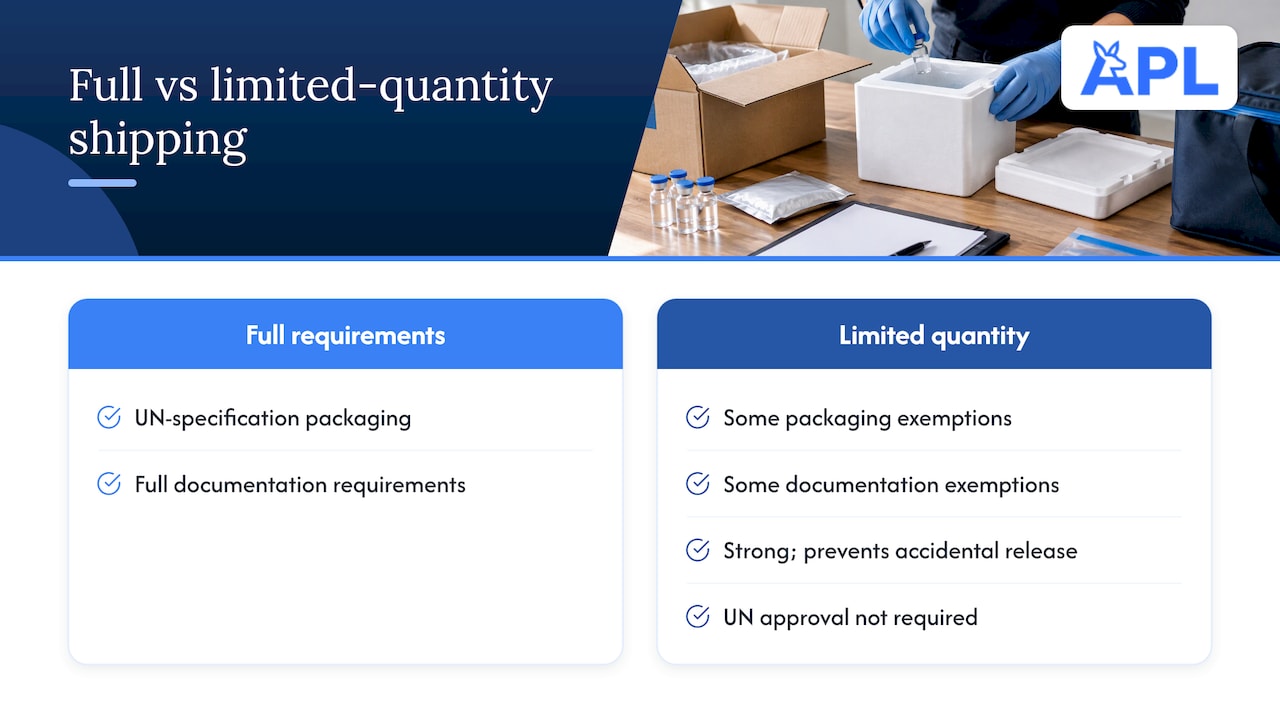
If a product is classified as dangerous goods, the Code sets requirements for packaging, marking, labelling and transport documents. The scale of those obligations depends on whether the shipment qualifies for limited-quantity (LQ) provisions.
The NTC's limited quantities guidance, prepared against ADG 7.7, explains that LQ provisions allow certain exemptions from full UN-specification packaging and documentation requirements, provided inner and outer packaging meet specific performance and quantity criteria. It states that limited-quantity packaging must be suitably strong and designed to prevent accidental release under normal transport conditions, but does not have to be UN-approved. The quantity limits depend on the entry, so they must be read from the Code and not assumed.
Small vial quantities are the typical reason research chemicals can qualify under LQ provisions where a class applies at all. That is a consequence of the quantity per package, and it does not change the class. A consignment can be both classified and low-burden to ship.
For laboratories that handle packaging themselves, our overview of peptide packaging materials describes material choices for sealed vials.
Why classification differs between countries
Peptides sourced from overseas enter a different chain of paperwork. A study published in the journal of the American Chemical Society's chemical health and safety division, Chemical Health & Safety, 2022, notes that inconsistent implementation of the Globally Harmonized System across countries can give the same substance different hazard classifications depending on the jurisdiction. That complicates international transport and SDS compliance.
For a laboratory, the consequence is concrete. An SDS prepared for another market may describe hazards using that market's classification and may not reference the ADG Code at all. A locally prepared SDS, written against the Australian framework, removes that mismatch.
Perspective: classification is a documentation question first
Laboratories frequently ask us whether peptides are dangerous goods, and the accurate answer is that the question is posed at the wrong level. The ADG Code classifies substances according to their demonstrated properties, so the unit of analysis is the individual product, its formulation and its quantity per package, never the word "peptide".
Our position is that a supplier should resolve this before a consignment leaves the warehouse and should record it in a form the receiving laboratory can verify. For that reason, we dispatch from Melbourne within one business day, which keeps the consignment inside the Australian domestic framework and removes the customs stage at which classification and documentation inconsistencies most often surface. Every batch is independently third-party tested to a purity of 99% or above, and the COA for each batch is available so that the identity and composition of what is received can be matched against its documentation.
Domestic supply does not replace the receiving laboratory's own duties. A laboratory should file the current SDS, confirm the Section 14 entry against the Edition 7.9 Code, and apply its own WHS storage assessment, which, as noted above, uses a different classification system from transport. Our products are supplied strictly for laboratory research and are not for human or veterinary use.
Au Peptide Labs editorial team
Supplying research peptides from Melbourne
Orders are dispatched from Australia within one business day, and Express Post is available for $10. Custom orders and bulk procurement can be arranged for institutions and companies. The Au Peptide Labs store lists the full range.
Practical checklist for a new peptide consignment
A laboratory or procurement team can apply the following sequence to any new peptide product:
- Obtain the SDS and COA before ordering. Confirm that both identify the same product and batch format.
- Read Section 14. Look for the UN number, proper shipping name, class, packing group and Hazchem code, or an explicit statement that the product is not regulated for transport.
- Check the formulation. If a solvent or buffer is supplied with the peptide, confirm that the classification covers the mixture as shipped.
- Confirm the Code edition. Edition 7.9 has been mandatory since 1 October 2025.
- Separate transport from storage. Assess storage using the WHS classification and the SDS hazard statements, not the transport class.
- Record the result. Keep the SDS, the COA and the internal assessment with the purchase record.
Importers bringing material from abroad should also be aware of the regulatory context.
A note for readers who are not laboratory purchasers
This page addresses transport classification, which is a matter for consignors, carriers and laboratories.
FAQ
Are peptides dangerous goods in Australia?
Not as a category. The ADG Code classifies each substance according to its named entry or, where none exists, its determined properties. A given peptide product may or may not meet the criteria of a class, and the answer is recorded in Section 14 of its SDS.
Which dangerous goods class could a peptide fall into?
The classes most often tested are Class 6.1 for toxic substances, and Classes 3, 8 or 9 where a solvent or formulation introduces flammable, corrosive or miscellaneous hazards. Division 6.2 concerns infectious substances and relates to biological preparations, not to synthetic peptide powders.
What does Section 14 of a peptide SDS contain?
It states the UN number, proper shipping name, transport hazard class, packing group where applicable, environmental hazards and the Hazchem code, as required by the ADG Code. If the product is not regulated for transport, the section says so. A missing or unclear section should be queried with the supplier before the product is shipped or stored.
Which edition of the ADG Code applies now?
Edition 7.9 is the latest edition and has been mandatory since 1 October 2025. Check the NTC page for any later edition, and confirm that the SDS references the current one.
Is the transport class the same as the workplace hazard class?
No. Transport uses ADG classes, while WHS placard and manifest requirements use GHS hazard classes and categories. A laboratory should assess storage under the WHS framework separately from the transport classification.
Sources
- NTC: Australian Dangerous Goods Code
- Safe Work Australia: Placard and manifest requirements under the WHS regulations
- CASA: Dangerous goods classes and hazard labels
- NTC: ADG Code review, draft Part 2, Classification
- ADG Code Volume I, Edition 7.9
- Safe Work Australia: Classifying hazardous chemicals, national guide
- NT WorkSafe: Transportation of dangerous goods
- Safe Work Australia: Preparation of safety data sheets for hazardous chemicals
- NTC: Limited quantities guidance
- Chemical Health & Safety, 2022: GHS implementation differences