
A laboratory fridge needs an automatic backup supply that takes over the instant mains power fails, sized to the fridge's real load and tested on a schedule. For most Australian labs that means an online UPS with a pure-sine-wave output, and an external battery bank if the runtime must be longer. A generator is added only where outages run for many hours, and it is connected through a changeover switch by a licensed electrician. At Au Peptide Labs, research peptides are dispatched from Melbourne within one business day, so protecting stock after it arrives is the natural next concern. The sections below cover the full routine.
Au Peptide Labs supplies research peptides for laboratory research use only, each batch independently tested with a certificate of analysis.
Why a laboratory fridge needs backup power
A refrigerated cabinet holds its temperature only while the compressor runs. Once power is cut, the interior warms, and the safe window can be short. Australian Government guidance for vaccine storage notes that a purpose-built refrigerator may warm quickly during an outage, and it recommends monitored alternative storage at +2°C to +8°C so that loss and disruption are kept to a minimum. Vaccines are a health-sector example, but the same +2°C to +8°C band is the working range for many refrigerated reagents and research peptides, so the reasoning carries over to a laboratory.
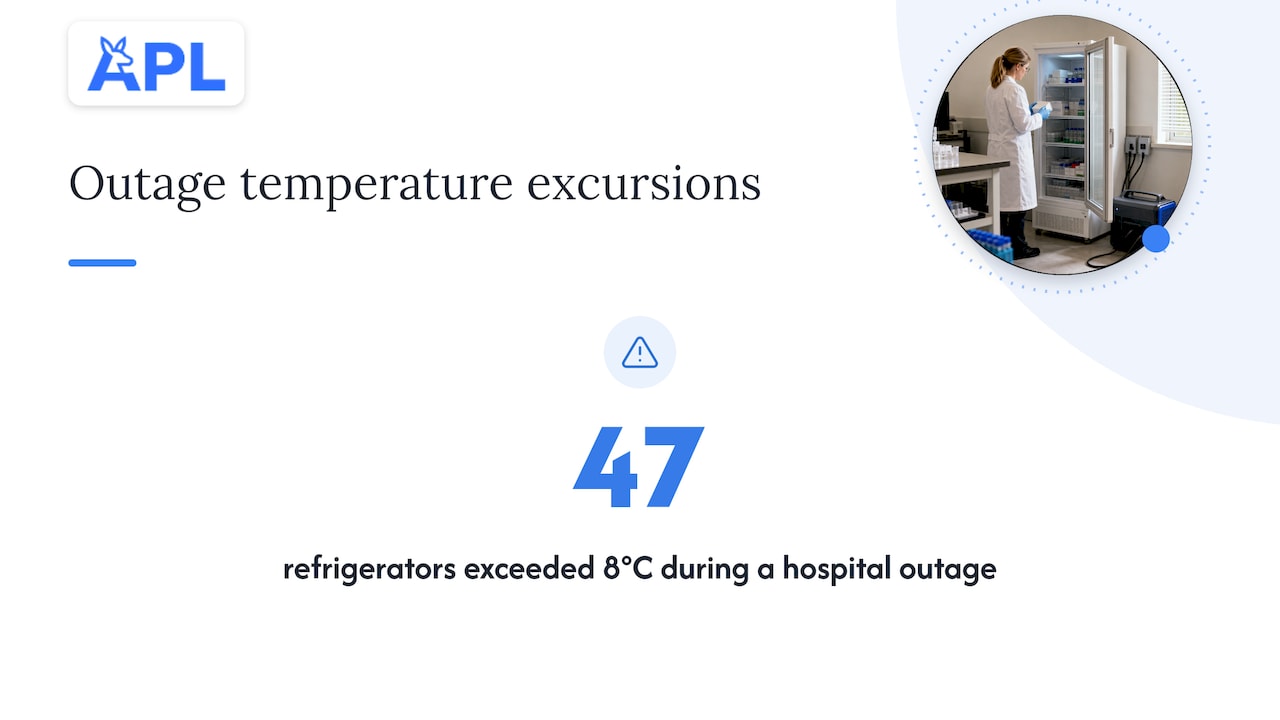
The consequence of weak planning is documented. A hospital case report on an outage found 47 refrigerators with excursions above 8°C. A stability review then separated salvageable stock from unusable stock, which is why quarantine, records and expert stability decisions all matter after an event. A backup supply reduces how often that review is needed at all.
The same guidance also states that domestic refrigerators, including bar fridges, must not be used for vaccine storage. The expectation is a purpose-built, monitored unit or a prepared alternative. For a laboratory, the practical reading is that the fridge, its monitoring and its backup supply are designed as one system.
Choosing between a UPS, a battery system and a generator
The Department of Health lists a generator or battery/solar backup among the ways to keep storage within range during a power failure. Each option suits a different failure profile.
| Option | Switchover | Typical role | Main consideration | | --- | --- | --- | --- | | UPS with internal battery | Automatic, no gap | Short and medium outages for one or two units | Runtime is fixed by battery capacity | | UPS with external battery bank | Automatic, no gap | Extended outages for critical cabinets | Larger footprint, battery maintenance | | Generator with changeover switch | Manual or automatic transfer | Multi-hour or multi-day outages, whole-room loads | Licensed installation, fuel, servicing |
The Royal Australian College of General Practitioners explains that UPS battery systems can supply a fridge automatically when mains power is cut or the voltage drops, then stop and recharge when mains returns. It describes typical UPS duration as 36 to 48 hours. Actual runtime depends on the fridge load and the battery configuration, so the sizing step below is what turns that range into a figure for your cabinet.
For medical refrigeration, one Australian UPS manufacturer's guidance recommends a 2 kVA rackmount UPS, the PSCRT2000, with external battery configurations available. The unit's manual specifies a nominal Australian 240 V input and a pure-sine-wave battery output, with a capacity of 2,000 VA and 1,600 W. Pure sine output matters because compressor motors are inductive loads.
A generator alone leaves a gap while it starts. A UPS bridges that gap, so the two are complementary rather than competing choices.
Sizing capacity and runtime for your equipment
Sizing has two separate questions: how much instantaneous power the UPS must deliver, and how long the battery must sustain it. An Australian application note on medical refrigeration says selection must account for mains supply, refrigerator category and temperature, continuous load, compressor-start peak demand, required runtime, reliability, maintainability and ambient noise. It adds that the load should be assessed in all duty cycles, using average and peak profiles.
Step 1: list the load
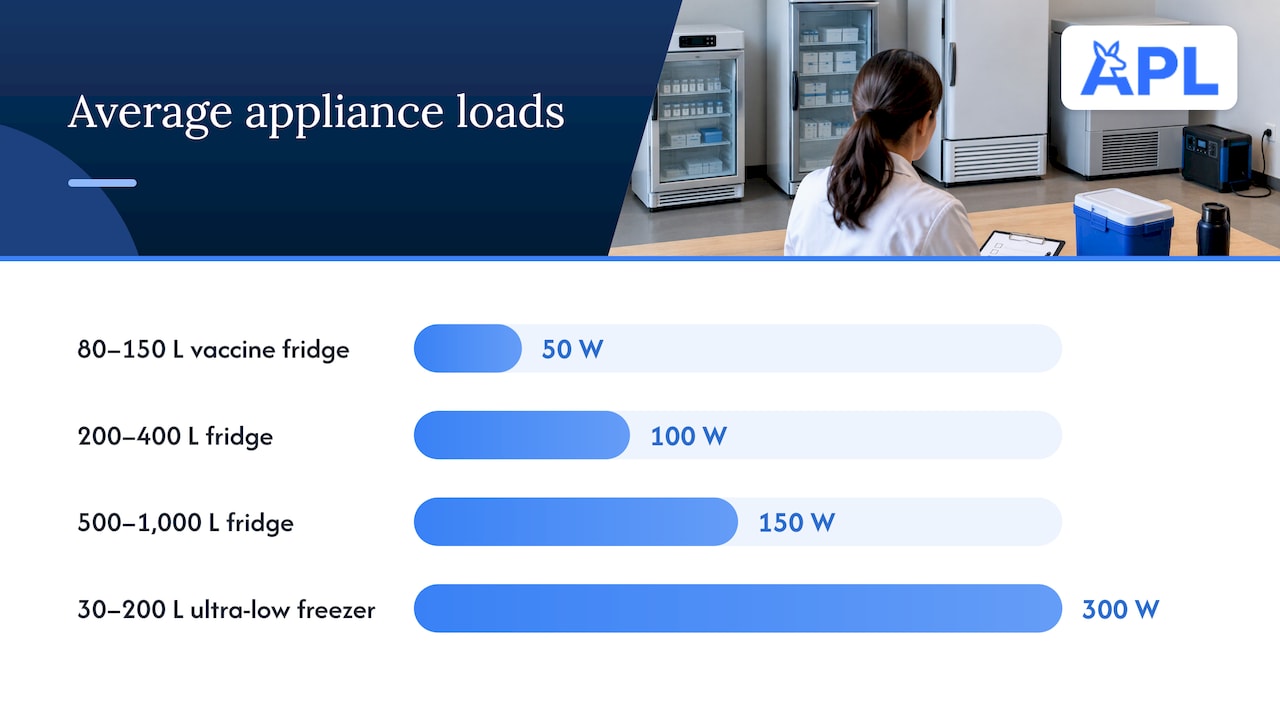
The same note gives average loads from manufacturer data: 50 W for an 80 to 150 L vaccine fridge, 100 W for a 200 to 400 L fridge, 150 W for a 500 to 1,000 L fridge and 300 W for a 30 to 200 L ultra-low-temperature freezer. Use the nameplate rating of your own unit where you have it, and list every item that must stay live: fridge, freezer, data logger base station and any alarm dialler.
Step 2: convert watts to VA and add headroom
UPS ratings are in volt-amperes. Eaton's Australia and New Zealand handbook says watts convert to VA by dividing by the power factor. Its sizing method is to list all protected equipment, convert amps and volts to VA where needed, add the subtotals, multiply the total by 1.2 for expansion, and choose a UPS whose VA rating is not exceeded.
Worked example
The figures below are an illustration only. The power factor of 0.8 is an assumed value, so substitute the one on your equipment's data sheet.
| Item | Average load | | --- | --- | | 200 to 400 L laboratory fridge | 100 W | | 30 to 200 L ultra-low-temperature freezer | 300 W | | Total average load | 400 W | | Converted to VA at an assumed power factor of 0.8 | 500 VA | | With the 1.2 expansion factor | 600 VA |
This is the average figure. Compressors draw a higher peak at start-up, so the UPS must be rated against that peak as well, and a 2,000 VA unit has generous headroom for this pair. For runtime, the energy needed is the average load multiplied by the hours required: 400 W for 24 hours is 9.6 kWh before conversion losses. That number is what the external battery configuration has to be specified against, and it is why a longer target means more batteries rather than a larger inverter.
Compatibility and installation checks in Australia
Before buying, confirm four points: input voltage, output waveform, capacity against peak load, and the protections built in. The PSCRT2000 manual, for example, lists overload, discharge, thermal, short-circuit and overcharge protection, which is the kind of specification to compare across any model.
Plug-in UPS units connect to a standard outlet and need no switchboard work. A permanent generator connection is different. One Australian guide states that it should be installed by a licensed electrician using a changeover switch to prevent backfeed, in compliance with AS/NZS 3000 and AS/NZS 3010. AS/NZS 3000:2018 is the Wiring Rules standard, covering the design, construction and verification of electrical installations, including the selection and installation of equipment. Never improvise a switchboard connection or backfeed a building from a portable generator. Engage a licensed electrician for any fixed wiring.
Two practical checks complete this stage:
- Mark or lock the power source against accidental disconnection. The Strive for 5 material says the power source should be clearly marked or locked for this reason.
- Confirm that ambient temperature and noise suit the UPS location, since both are listed selection factors in the application note above.
Alarms and independent temperature monitoring
Backup power keeps the compressor running, but it does not tell you the fridge is in range. Strive for 5 expects each vaccine refrigerator to have an audible alarm for deviations outside +2°C to +8°C. It also recommends a separate battery-operated minimum/maximum thermometer or data logger during outages, because not every refrigerator displays its current temperature.
The independent logger is the useful part of that recommendation. If the fridge controller and the logger both depend on the same supply, a single fault removes both. For a deeper treatment of mapping and logging, see the guide to 48 to 72 hour mapping for storage temperature monitoring and the notes on building a stability database through cold chain validation.
Testing and maintenance schedule
Australian guidance asks facilities to document the backup plan and practise it. For the interval of individual checks, the New Zealand Blood Service refrigeration guideline is a useful neighbouring health-sector benchmark, though it is not Australian law. It requires temperature records, alarm and maintenance evidence, and specifies six-monthly recorder and alarm accuracy checks and annual two-point calibration against a traceable reference thermometer.
The same guideline recommends a routine that can be adopted as a laboratory schedule:
| Interval | Check | | --- | --- | | Daily | Review temperature stability | | Monthly | Cleanliness, door seals and alarm backup batteries | | Six-monthly | Mechanical checks including condenser and compressor, and recorder and alarm accuracy | | Annually | Two-point calibration and spatial temperature-distribution testing |
Those intervals come from the refrigeration guideline. Add the UPS to the list. The PSCRT2000 manual states an expected battery service life of about 3 to 5 years at 25°C, after which batteries should be replaced, and stored units need periodic recharging, more often in warm conditions. Record the installation date on the unit and schedule replacement in the equipment register. A full-load transfer test, performed by switching off the supply to the UPS under supervision, shows whether the runtime assumption holds.
What to do during and after an outage
Preparation decides the outcome, because the safe window may be short. Strive for 5 says facilities should prepare alternative storage before an outage. Its sequence for refrigerated vaccines translates directly to other temperature-controlled stock:
- Keep the fridge door closed.
- Monitor the temperature.
- Move contents to prepared, monitored storage when the temperature reaches +8°C.
- When power returns, isolate out-of-range items and seek advice from the relevant health department or, for research materials, the manufacturer's stability data.
The Department of Health appendix gives specifications for the outage cooler: it must hold the stock, ice or gel packs, insulating material and a minimum/maximum thermometer or data logger. Temperature should be recorded every 15 minutes for the first two hours and at least hourly once stable. Keep the log with the batch records, since it supports any later stability decision.
Protecting peptide stock after delivery
Cold chain protection does not begin at the laboratory door. Research peptides ordered from Au Peptide Labs ship from Melbourne with no customs delay, and batches carry third-party purity certificates. Express Post is available for $10 where timing matters. Once the order arrives, the backup supply described above is what keeps the cabinet in range. Stability guidance is on the storage and stability page, and arrival checks are covered in the guide to 2 to 8°C cold chain shipping and verification.
Laboratory consumables are listed under Lab Supplies. All products are strictly for laboratory research and not for human or veterinary use. Teams that want to avoid running short between deliveries can use the 90 day rolling forecast for peptide stockouts, which also reduces how much stock sits in a fridge at risk at any one time.
Perspective
Backup power is best understood as part of the chain of custody of a reagent. A certificate of analysis documents purity at release, and the storage environment is what preserves that value afterwards. A cabinet that drifts above +8°C overnight can undermine a batch regardless of how well it was made.
This is the reasoning behind our own approach. We stock research peptides in Australia and dispatch from Melbourne within one business day, so that product reaches the bench without customs delays and with its third-party COA intact. Local dispatch shortens the interval during which material is outside controlled storage, and a laboratory with a sized, tested UPS and an independent logger extends that control through the point of use.
Our recommendation to research teams is to treat three records as one file: the batch COA, the arrival temperature check and the cabinet's temperature log. When all three are in order, a stability question after an outage can be answered from documents rather than assumptions.
Au Peptide Labs editorial team
Frequently asked questions
How long will a UPS run a laboratory fridge?
Runtime depends on the load and the battery capacity. The RACGP describes typical UPS duration as 36 to 48 hours for vaccine fridges, and external battery banks extend it. Calculate your own figure by multiplying the average load in watts by the hours required, then size the batteries to that energy.
Can I plug a laboratory fridge into a generator directly?
A plug-in connection of a single unit is a different matter from wiring a generator into a building. A permanent connection to the switchboard needs a licensed electrician, a changeover switch and backfeed prevention, and it must comply with AS/NZS 3000 and AS/NZS 3010. Never backfeed the switchboard from a portable generator.
Is a standard home battery enough for a laboratory fridge?
The fridge needs a supply with automatic switchover, a suitable output waveform and capacity for compressor-start peaks. A UPS selected for medical refrigeration meets those points by design. Check the specifications against the load calculation above before relying on any battery product.
How often should backup power and alarms be tested?
Practise the written backup plan regularly, as Australian guidance advises. As a benchmark, the New Zealand Blood Service guideline sets six-monthly alarm and recorder accuracy checks and annual calibration, and UPS batteries should be replaced after the service life stated in the manual, about 3 to 5 years for the model cited above.
Sources
- National vaccine storage guidelines, Appendix 7: checklist for managing a power failure (Department of Health, 2025)
- Management of refrigerated medications during and after a hospital outage (SHPA)
- Strive for 5: managing a power failure
- National vaccine storage guidelines, Strive for 5
- RACGP: managing vaccines and other refrigerated medicines
- Medical refrigeration UPS application note (2024)
- Commander PSCRT2000 instruction manual
- Eaton UPS and power management fundamentals handbook (ANZ)
- Changeover switch vs ATS guide
- AS/NZS 3000:2018 Wiring Rules
- New Zealand Blood Service refrigeration guideline